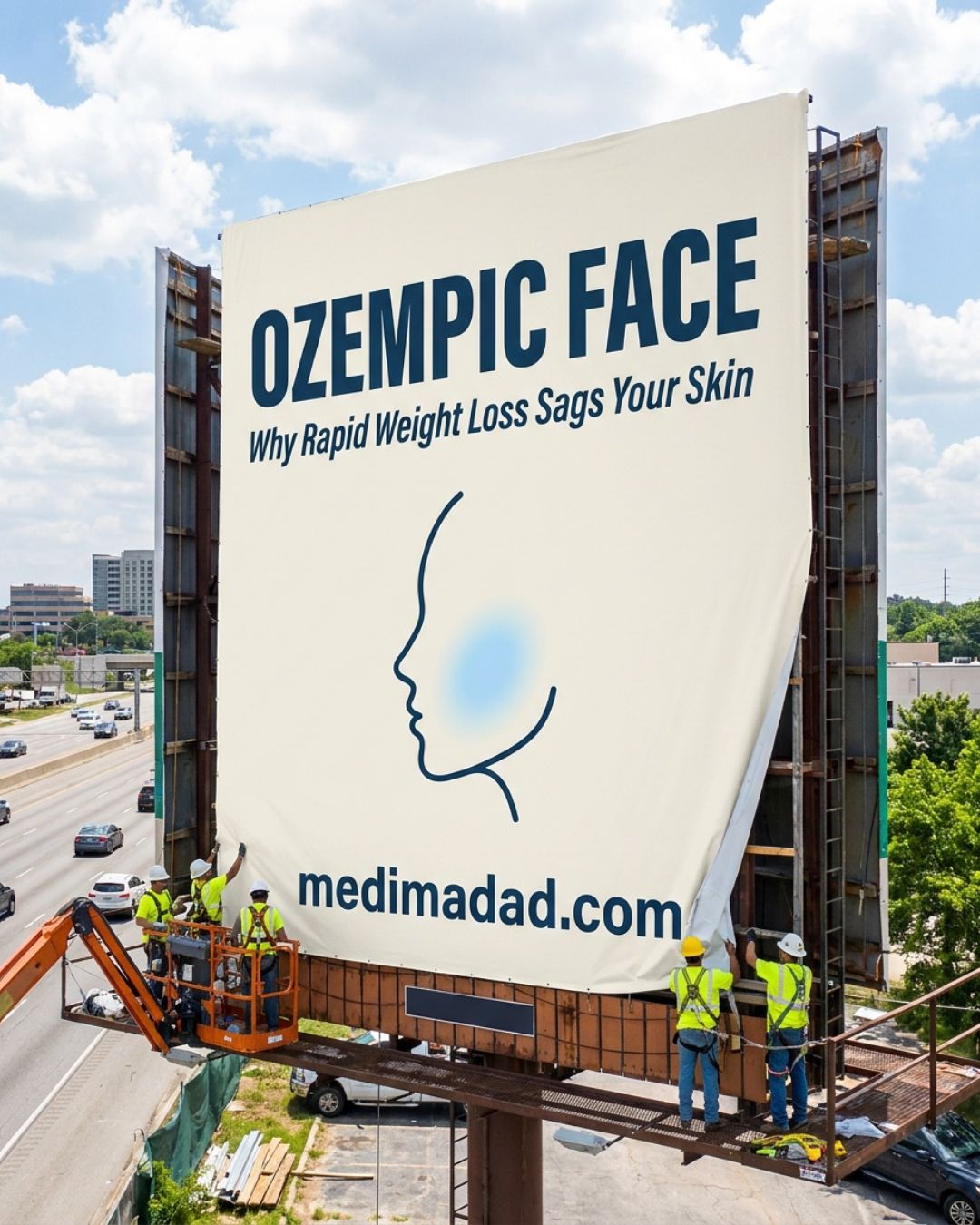

A person on semaglutide or tirzepatide can lose 15-20% of their body weight in under a year — a pace that used to be reserved for bariatric surgery. The scale moves the way everyone wanted. The face, unfortunately, doesn’t always get the memo gracefully. Sunken cheeks, hollow temples, skin that looks a size too big for the bone underneath — dermatologists have started calling it “Ozempic face,” and enough people are asking about it that it’s now a recurring topic in cosmetic dermatology clinics, not just a TikTok trend.
It’s worth being precise about what’s actually happening here, because most of what circulates about it online is either alarmist or trying to sell you something. Neither is particularly useful. What’s actually useful is understanding the mechanism, and understanding which prevention strategies have real evidence behind them versus which ones are just marketing dressed up as skincare science.
What’s actually happening to your face
Your face isn’t just skin over bone. It’s built on discrete pads of fat — in the cheeks, temples, and around the eyes — that give the face its youthful volume and, just as importantly, physically support the skin sitting on top of them. When you lose weight quickly, those fat pads shrink along with the rest of your body fat. The skin that was stretched over them doesn’t have anywhere to go, so it sags instead.
Northwell Health puts it plainly: rapid weight loss shows up in the face first, and the faster it happens, the more visible the change. This isn’t unique to GLP-1 drugs — the same hollowing and sagging shows up after bariatric surgery or aggressive dieting. GLP-1 medications didn’t invent this phenomenon; they just made rapid, sustained weight loss accessible to far more people at once, which is why dermatologists are suddenly seeing it constantly.
There’s also a cellular piece to the story. Dermatologist Dr. Sabrina Fabi has described a second mechanism: the same GLP-1 receptor activity that reduces appetite may also blunt glucose uptake in adipocyte-derived stem cells in the skin — the cells that would otherwise differentiate into the fibroblasts responsible for producing collagen, elastin, and hyaluronic acid. Less raw material for skin structure, on top of less fat volume underneath it, is a reasonable explanation for why the skin looks not just thinner but less resilient.
How common is this, really
Here the honest answer is: more common than a footnote, but the best available number needs a caveat attached to it. An Allergan Aesthetics-commissioned provider survey, reported by outlets including Dermatology Times and NewBeauty in 2026, found that among clinicians treating GLP-1 patients, 61% reported midface volume loss as a presenting concern, 50% reported skin laxity, and 35% reported new wrinkles or folds. Those are striking figures, but they come from an industry-sponsored survey of providers’ clinical impressions — not a peer-reviewed, controlled study measuring outcomes in patients directly. Treat it as a directional signal from people who see this in clinic every day, not as an established population-level rate.
What’s better established is the mechanism itself, which multiple independent sources — Northwell Health, Cleveland Clinic, and dermatology researchers writing in Healio — describe consistently: fat pad loss plus rapid pace plus reduced skin-remodeling capacity. That convergence is more reassuring, scientifically, than any single percentage.
What actually helps — and what’s just being sold
This is the part worth reading slowly, because it’s the difference between evidence-based prevention and a jar of hope.
Adequate protein intake. The clearest, most consistent finding in the recent GLP-1 research isn’t about skin directly — it’s about lean mass, which skin laxity is downstream of. A small case series of patients on semaglutide or tirzepatide who combined resistance training with protein intake in roughly the 1.2-2.0 g per kilogram of body weight range preserved lean soft tissue even while losing 13-33% of total body weight; some participants gained lean mass. A separate cohort study of around 200 adults combining GLP-1 therapy with resistance-training guidance and individualized higher protein intake saw roughly 13% total weight loss but only about 3% of that loss coming from muscle — a much smaller share than typically seen with diet-only weight loss. Less lean tissue lost generally means more underlying structural support for the skin, even though no study has directly measured facial skin laxity as an endpoint yet.
Resistance training. The same studies point the same direction: 3-5 sessions a week of resistance training, alongside sufficient protein, is the combination associated with preserved lean mass during GLP-1-driven weight loss, not either one alone. A registered clinical trial (LEAN-PREP) is currently testing this combination specifically in semaglutide and tirzepatide patients, which tells you the evidence base, while promising, is still being built rather than fully settled.
A slower rate of loss. Clinical guidance has long suggested that gradual weight loss — roughly 1-2 pounds a week, the pace the CDC has recommended for general weight management — gives skin more time to remodel and contract compared with rapid loss. This is physiologically sensible and consistent with what dermatologists report seeing clinically. It’s worth being honest, though, that the size of this advantage hasn’t been quantified in a head-to-head trial against faster GLP-1-driven loss — it’s a reasonable, widely-held clinical inference, not a number with a confidence interval attached. If your weight loss is happening quickly under medical supervision, this is a genuinely useful thing to discuss with your prescriber rather than something to manage alone.
What doesn’t have real evidence behind it: topical “firming” creams, at-home radiofrequency devices, and collagen supplements marketed specifically at “Ozempic face” are, for the most part, riding a trend rather than resting on trial data specific to this condition. That doesn’t mean every skin-supportive habit is useless — but a cream cannot replace a fat pad, and no supplement has been shown to reverse volume loss once it’s occurred. Cosmetic options — dermal fillers, energy-based skin tightening, and similar procedures — do exist and some patients pursue them successfully, but which approach, if any, makes sense is a conversation to have with a qualified dermatologist or facial plastic surgeon who can assess your specific face, not a decision to make from an ad.
The bottom line
“Ozempic face” isn’t a mysterious new drug side effect — it’s the same rapid-weight-loss skin story dermatologists have seen for decades, just showing up in far more people because GLP-1 drugs made large, fast weight loss common. The two levers with real evidence behind them are the same two that show up everywhere else in this drug class’s story: enough protein, and enough resistance training, paired with a pace of loss your body and skin can actually keep up with. None of that guarantees you’ll avoid every visible change — genetics, age, skin quality, and total amount lost all play a role too — but it’s the difference between doing something with real physiological logic behind it and buying a product built on a trend.
General health information, not a substitute for personalized medical advice — talk to your prescriber or a dermatologist about your specific situation before changing your treatment plan.
Further Reading on Medimadad
The muscle-loss side of this same story gets a closer look in Mounjaro vs Ozempic: Which One Destroys More Muscle? — useful background if you want the fuller picture on lean mass during GLP-1 treatment. If you’re building the resistance-training side of this into your own routine, Fitness in the GLP-1 Era covers it in more depth. And if facial changes aren’t the only cosmetic side effect you’ve noticed, Ozempic and Hair Loss: Why It Happens and What You Can Do walks through a related, evidence-backed concern.
Beyond the GLP-1 cluster specifically: rapid physical change like this often comes with a psychological adjustment too, and Doomscrolling: The Psychology Behind It and How to Stop is a good example of Medimadad’s Mind and Meanings coverage if that side of health interests you. Anyone weighing whether cosmetic treatment is worth the cost might also find Critical Illness Insurance, Explained a useful, unrelated-but-practical read on how health spending decisions get made in India.
