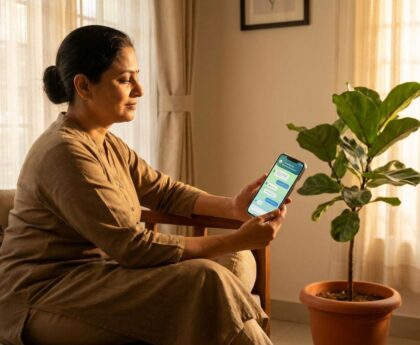

There’s an app in India right now where you can open a chat window, and your AI “Mummy” asks if you’ve eaten yet. Not a customer support bot. Not a wellness app with breathing exercises. An avatar named Maa, or Papa, or Dadi, built specifically to sound like the family member you left behind when you moved cities for work.
That app is called Parivar AI, and it isn’t a novelty experiment. It’s one of a small but real cluster of Indian companion-chatbot products — alongside apps like Flingo, which says it has crossed 900,000 downloads across more than 80 Indian cities — built specifically around the idea that a lot of people here are lonely, moving, working long hours away from home, and would rather talk to something than talk to no one.
The question worth asking isn’t whether these apps exist. They clearly do, and they’re growing. The question is whether talking to one actually helps.
What these apps are actually selling
Parivar AI’s pitch is narrow and deliberate: not a general assistant, not a romantic partner, but family. You pick a relationship — Mummy, Papa, Dadi, Bhaiya — and shape a personality, a way of speaking, a set of “memories.” The avatars respond in Hindi or Hinglish, the way people actually talk to their own families, using speech models tuned for natural code-switching rather than textbook Hindi. The stated audience is India’s very real population of people living away from home, in a different city or country, who don’t get a daily call from someone who “worries and scolds.”
Flingo sits at the other end of the same market — AI companions built into a real dating app, aimed at people who want conversation, flirtation, or just a responsive presence at a price point closer to a few rupees than a few dollars a month. Both products are explicit that affordability and Indian-language fluency are the differentiators against global apps like Replika or Character.AI, which were never built with Hinglish or Indian family dynamics in mind.
None of this is hidden or accidental. These are venture-backed products, marketed openly, built around a real gap: distance from family, long work hours, and, for a meaningful number of people, not having anyone to talk to in the moment they want to.
What the research actually shows — and it’s genuinely mixed
Here’s where it gets less clean than either a “this is dangerous” story or a “this is the answer to loneliness” story would like.
A 2026 study published in Acta Psychologica looked at 233 young adults in India and measured how their use of conversational AI related to loneliness, social anxiety, and quality of life. The result: a small, non-significant association between AI chatbot use and lower loneliness and social anxiety. Not zero — the correlations existed (loneliness r = −0.18, social anxiety r = −0.12) — but too weak and too statistically uncertain to call it a real effect. The same study found something more interesting underneath: greater loneliness predicted more chatbot use, while more chatbot use was tied to somewhat lower loneliness at the same time — a pattern the researchers describe as reciprocal rather than one-directional. In plain terms: lonelier people reach for these apps, and using them doesn’t clearly make things worse, but it doesn’t reliably make things better either. The data is cross-sectional, so none of it proves cause and effect in either direction.
That sits alongside two other data points worth knowing. A much larger Japanese study of over 14,000 adults found AI companion use associated with higher life satisfaction and happiness, particularly among people who were already highly lonely — a more encouraging signal, though from a different country and a different app landscape. And a separate experimental comparison found that talking to an actual human produced greater psychological benefit for loneliness than talking to a chatbot did — which is close to what most people would guess, but is useful to have confirmed rather than assumed.
Put together, the honest read is this: these apps are not a proven fix for loneliness, and the fear that they’re quietly making an entire generation worse off isn’t well supported by the evidence either. What exists is a modest, complicated signal — helpful for some people in some moments, not a substitute for anything, and not yet well studied enough in India specifically to say much more than that.
Why this is landing in India right now
Part of the reason these apps found an audience here isn’t mysterious. India has roughly 0.75 psychiatrists for every 100,000 people, well under the World Health Organization’s suggested benchmark of 1.7, and national survey data has put India’s mental health treatment gap — the share of people with a diagnosable condition who get no care at all — somewhere between 70% and 92%. Apps like Wysa, a CBT-based chatbot built in India, have positioned themselves explicitly as a bridge into that gap: anonymous, available at 2am, cheaper than a clinic visit, useful as a first step rather than a replacement for one.
A companion chatbot that just wants to talk about your day is a different product from a CBT tool like Wysa, and it’s worth not collapsing the two together. But they’re answering a version of the same real shortage: not enough people to talk to, and not enough professionals to see.
The regulatory ground is starting to move
Regulators have started paying attention to exactly this category. California’s SB 243, signed in late 2025 and in effect from January 1, 2026, now requires companion-chatbot operators to clearly disclose that users are talking to an AI, not a person, and adds specific protections for minors, including crisis-referral protocols if a conversation touches on self-harm. It’s a US state law with no direct reach into India, but it’s an early signal that lawmakers are treating “AI built to feel like a relationship” as a distinct category worth its own rules — not just another chatbot.
A brief, honest note
This article is informational, not clinical advice, and it isn’t a substitute for professional mental health care. If loneliness, anxiety, or anything you’re carrying feels like more than you can manage alone, please reach out to a real person — a friend, a family member, or a mental health professional. iCall (9152987821) and the government’s Tele-MANAS helpline (14416) are both free, confidential, and staffed by trained people, not software.
The bottom line
An AI “Mummy” that asks if you’ve eaten is a genuinely clever product for a genuinely real problem: distance from the people who used to ask you that in person. Whether it actually eases loneliness is still an open, honestly mixed question — not a yes, not a no. Worth watching, not worth panicking about, and not worth trusting blindly either.
Further Reading on Medimadad
If this raised questions about how AI is already sitting inside healthcare and daily wellbeing decisions, two related pieces worth reading: Asking AI About Your Symptoms? A Doctor’s Guide looks at where AI health chatbots are actually reliable and where they’re not, and AI Mental Health Apps in India 2026 covers the wider landscape of apps like Wysa beyond companion chatbots specifically.