
By Dr. Ajit Kumar, MD (Medicine) — Founder, Medimadad. About the Author | Editorial Policy
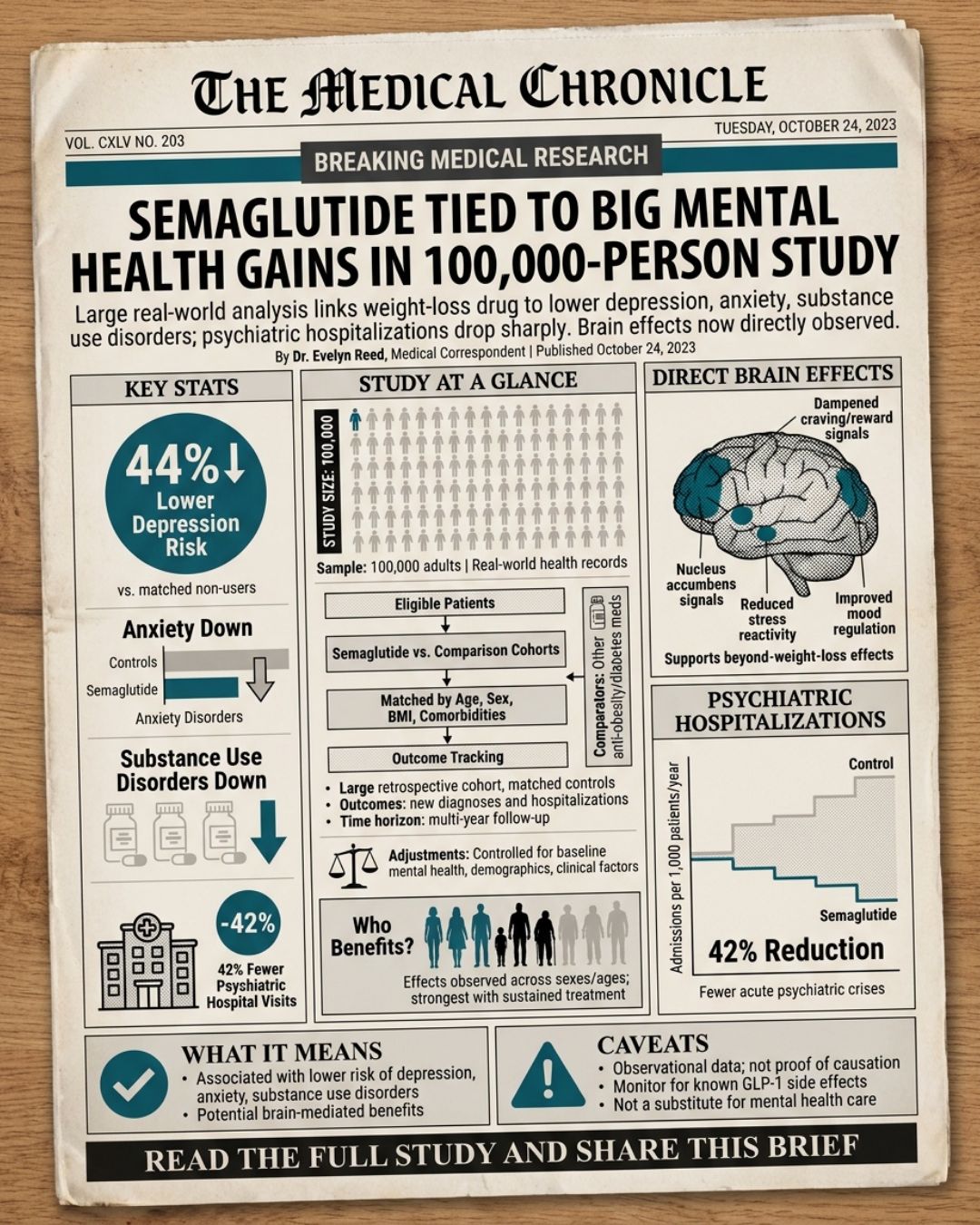
Of all the secondary findings to come out of the GLP-1 research boom, this is the one that surprised me most when I first read it. A registry study out of Sweden — tracking close to 100,000 people over 13 years, more than 20,000 of them on GLP-1 medications — found a 44% lower risk of depression and a 38% lower risk of anxiety disorders associated with semaglutide use. Published in The Lancet Psychiatry this May, it’s the largest study of its kind, and the effect size is large enough that it’s worth taking seriously rather than filing away as a curiosity.
What the researchers actually measured
The team, drawing on Swedish national health registers, compared each person against themselves — mental health outcomes during periods they were taking semaglutide versus periods they weren’t. That within-person design matters clinically: it controls for a lot of the confounding that would otherwise make you skeptical of a finding this size. Depression risk was 44% lower on the medication. Anxiety-related hospital episodes and sick leave dropped 38%. Overall psychiatric hospital care and sick leave fell 42%. And perhaps the most unexpected number: substance use disorder-related hospital care and work absence dropped 47%.
Professor Mark Taylor, one of the study’s authors, put the substance-use finding this way: “Alcohol-related problems often have downstream effects on mood and anxiety, so we expected the effect to be positive on these as well.” The team expected some effect. The magnitude still surprised them.
Why this might be happening — and why I’d be cautious about the “why”
The researchers are explicit that this is an association, not proven causation, and I think that caveat deserves more weight than it usually gets in coverage of this study. Several plausible mechanisms are under investigation, and they’re not mutually exclusive:
- The weight-loss effect itself. Improved body image, mobility, and reduced chronic pain all have well-documented mental health benefits independent of any drug mechanism.
- Blood sugar stabilization. Glucose swings affect mood; smoothing them out may reduce anxiety and depressive episodes on its own.
- Direct central nervous system effects. GLP-1 receptors are present throughout the brain, including regions tied to mood and reward. Dr. Markku Lahteenvuo has pointed to a plausible direct neurobiological pathway here, separate from the metabolic effects entirely.
- Reduced systemic inflammation. Semaglutide has anti-inflammatory properties, and chronic inflammation has a well-established link to depression.
In clinic, I’d frame this to a patient as: several plausible mechanisms, none of them proven individually, all pointing the same direction. That’s genuinely useful information even without a settled mechanism.
What this means if you’re already on a GLP-1
If you’re taking semaglutide for diabetes or weight management, this is reassuring background, not a reason to expect a specific personal outcome — population-level effect sizes don’t guarantee an individual result. What I’d actually take from this is permission to mention mood changes to your prescriber as a normal part of the conversation, rather than something separate from your metabolic treatment.
In India specifically, where both diabetes and depression carry real stigma and go under-discussed in routine visits, I think this finding has a practical use beyond the statistics: it gives patients and doctors a legitimate opening to talk about mood in a metabolic-health consultation, which doesn’t happen nearly often enough right now.
Recommended: Ashwagandha KSM-66 for Stress and Mood Support
Independent of any GLP-1 use, Ashwagandha KSM-66 is among the better-studied adaptogens for stress and mood — several trials have shown measurable reductions in cortisol and perceived stress.
This is an affiliate link – we may earn a commission at no extra cost to you. See our Affiliate Disclosure.
The bottom line
A 100,000-person, 13-year registry study is hard to wave away. Semaglutide use tracks with meaningfully lower rates of depression, anxiety, and substance-use hospitalization. Nobody has proven exactly why yet, and I’d resist any framing that treats this as a settled mental-health treatment rather than a striking association worth further study. If you’re on a GLP-1 medication already, it’s a reasonable thing to mention to your doctor — not a reason to start one for this reason alone.
Medically reviewed by Dr. Ajit Kumar, MD (Medicine) | Healthcare Consultant | Editorial Board Member, Medimadad Health Editorial Team. This article is for informational purposes only and does not constitute medical advice. Always consult a qualified healthcare professional before starting or changing any medication.
Further Reading
Get free weekly health insights from Dr. Ajit Kumar
Join thousands of readers. No spam. Unsubscribe anytime.
