

By Dr. Ajit Kumar, MD (Medicine) — Founder, Medimadad. About the Author | Editorial Policy
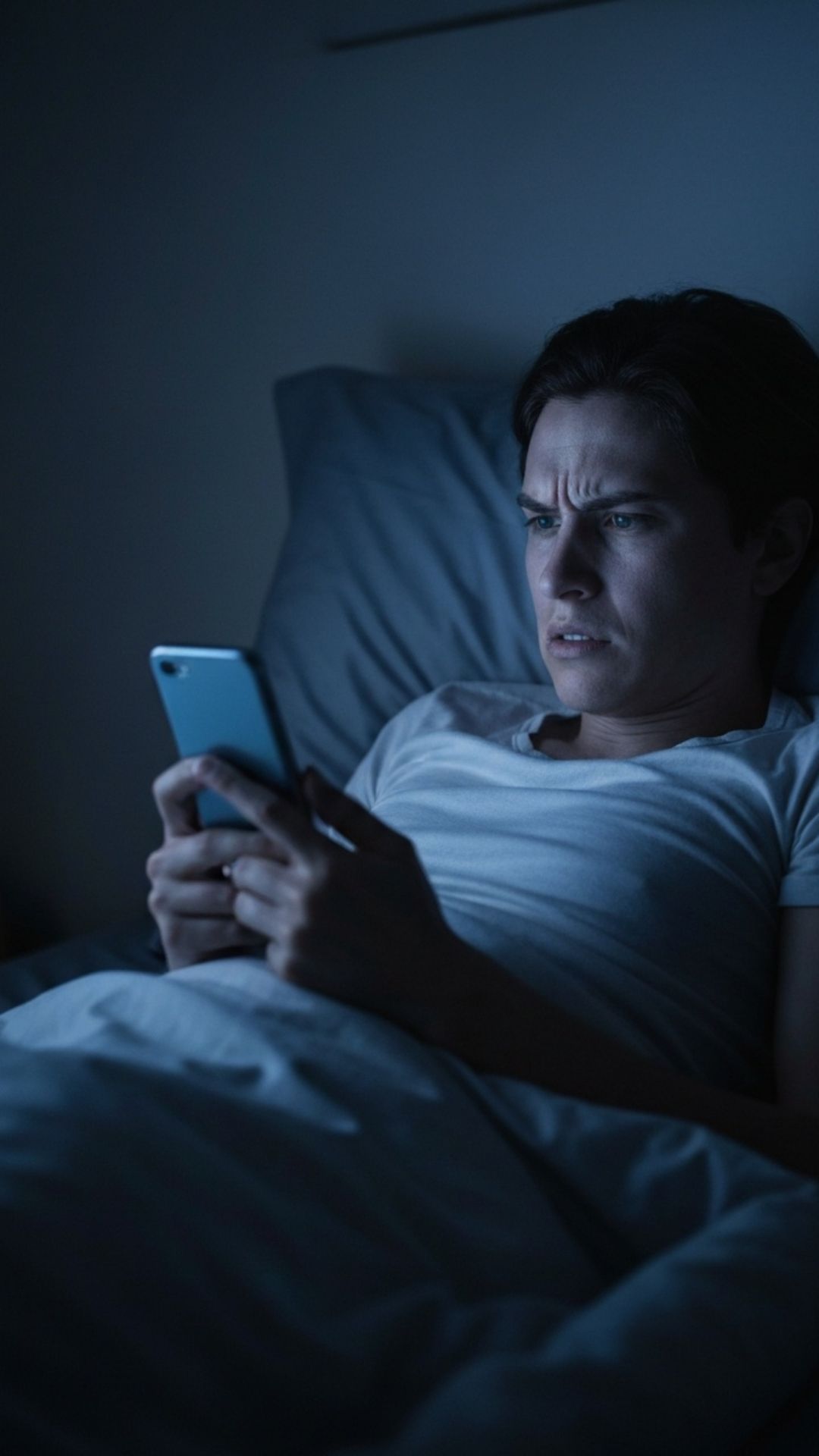
You tell yourself you’re just checking the news. Twenty minutes later you’re still scrolling, your chest is tight, and none of what you’ve read has actually been useful to you. This pattern has a name now — doomscrolling — and psychologists have spent the last few years figuring out exactly why it is so hard to stop, and what it is doing to your mood.
Why your brain keeps reaching for bad news
Doomscrolling isn’t a willpower failure. It exploits a genuine feature of human attention called negativity bias — a well-documented tendency for threatening or negative information to capture and hold attention more powerfully than neutral or positive information. This bias evolved for good reason: a distant ancestor who noticed the rustle in the grass survived better than one who didn’t. The problem is that a smartphone feed can manufacture an infinite stream of rustling grass, and your threat-detection system cannot tell the difference between a genuine nearby danger and a tragedy unfolding on another continent.
Layered on top of negativity bias is variable reward — the same psychological mechanism that makes slot machines compelling. You don’t know if the next scroll will surface something alarming, something reassuring, or something irrelevant, and that unpredictability keeps you scrolling in search of resolution that rarely comes.
What the research actually shows about the effects
Multiple studies conducted since 2020 — a period that gave researchers an unusually large, motivated sample of doomscrollers — found consistent associations between heavy negative-news consumption and worse mental health outcomes. A study by Satici and colleagues, published in Applied Research in Quality of Life (2022), introduced and validated a “doomscrolling scale,” finding that higher scores correlated significantly with anxiety, depressive symptoms, and lower life satisfaction.
What Doomscrolling Actually Does to Your Nervous System
Sustained cortisol elevation. Repeated exposure to threat-framed content keeps stress hormone levels elevated well past the individual moments of reading — the body responds to a headline the way it would to a real, present danger.
Disrupted sleep. Late-night scrolling sessions combine screen-light exposure with emotionally activating content — a combination that delays sleep onset and reduces sleep quality even when total time in bed is unchanged.
A false sense of helplessness. Consuming large volumes of distressing news about events you have no ability to influence is associated with reduced perceived control — a psychological state closely linked to depressive symptoms.
Diminishing informational return. Past a certain point, additional scrolling adds emotional cost without adding meaningfully new information — most of what appears after the first few minutes is repetition or elaboration of the same events.
Breaking the cycle without cutting yourself off from the news
The goal isn’t to become uninformed — it’s to consume information in a way that leaves you able to act on it, rather than just marinating in it. A few approaches with reasonable evidence behind them:
Set a scheduled news window instead of grazing
Checking news at two fixed times a day, rather than in response to every notification, reduces total exposure without meaningfully reducing how informed you are. This works with the same logic behind our piece on breaking the symptom-checking spiral — scheduled, bounded checking satisfies the underlying urge without letting it run unchecked.
Ask “can I do anything with this information right now?”
If the honest answer is no, that piece of content is adding emotional weight without adding utility. This single question, asked consistently, is one of the more effective friction points people report for interrupting a scroll session.
Use the physical off-ramp, not just willpower
Removing news apps from your phone’s home screen, turning off breaking-news notifications, and keeping your phone outside the bedroom are all blunt but effective interventions — they add just enough friction to interrupt the automatic reach for your phone.
Pair hard news with something restorative
Deliberately following your news check with a few minutes of something unrelated and calming — a short walk, a conversation, a stretch — helps your nervous system down-regulate rather than staying activated for the rest of the day.
Supporting Your Stress Response Naturally
If doomscrolling has left you feeling persistently wound up, Ashwagandha KSM-66 is the most clinically studied form of ashwagandha — shown in controlled trials to meaningfully lower perceived stress and cortisol levels alongside behavioral changes like the ones above.
This is an affiliate link – we may earn a commission at no extra cost to you. See our Affiliate Disclosure.
When to take it more seriously
Occasional doomscrolling is close to universal and not, by itself, a clinical concern. It is worth a closer look — ideally with a mental health professional — if you notice it consistently disrupting your sleep, crowding out time with people you care about, or if the anxious feeling persists for hours after you’ve put the phone down rather than fading within a few minutes.
The Bottom Line
Doomscrolling works on your brain’s oldest threat-detection wiring, which is exactly why it feels so involuntary. It isn’t a character flaw — it’s a predictable response to an information environment engineered to hold attention. Scheduled checking, a concrete “can I act on this” filter, and physical friction between you and the endless scroll are small changes with real evidence behind them.
Written with editorial review by Dr. Ajit Kumar, MD (Medicine) | MA Psychology. This article is for informational purposes only and does not constitute mental health advice. If you are experiencing persistent anxiety or low mood, please consult a qualified mental health professional.
References
- Sharma B, Lee SS, Johnson BK. The dark at the end of the tunnel: Doomscrolling on Twitter. Psychology of Popular Media. 2022;11(1):1-13.
- Price M, Legrand AC, Brier ZMF, et al. Doomscrolling during COVID-19: The negative association between daily social and traditional media consumption and mental health symptoms. J Trauma Stress. 2022;35(2):710-722.
- Chekroud SR, Gueorguieva R, Zheutlin AB, et al. Association between physical exercise and mental health in 1.2 million individuals in the USA. Lancet Psychiatry. 2018;5(9):739-746.
Further Reading
Get free weekly health insights from Dr. Ajit Kumar
Join thousands of readers. No spam. Unsubscribe anytime.
