
By Dr. Ajit Kumar, MD (Medicine) — Founder, Medimadad. About the Author | Editorial Policy
Patients regularly ask me whether there’s a way to get some of what Ozempic does without a prescription. The honest answer is: partially, yes, and it’s worth understanding why — but I want to be upfront that nothing here comes close to matching what a GLP-1 receptor agonist does pharmacologically. What follows is real physiology, ranked by how solid the evidence actually is, not a “natural Ozempic” substitute.
The mechanism, briefly
GLP-1 (glucagon-like peptide-1) is a hormone your gut releases after eating. It signals fullness to your brain, slows gastric emptying so food stays in your stomach longer, and helps regulate blood sugar. GLP-1 medications work by flooding your system with a synthetic, long-acting version of this hormone at doses far beyond what diet alone can achieve. Certain foods and compounds do stimulate your body’s own GLP-1 release to a real but much smaller degree — worth using, not worth overselling.
What actually has decent evidence behind it, ranked
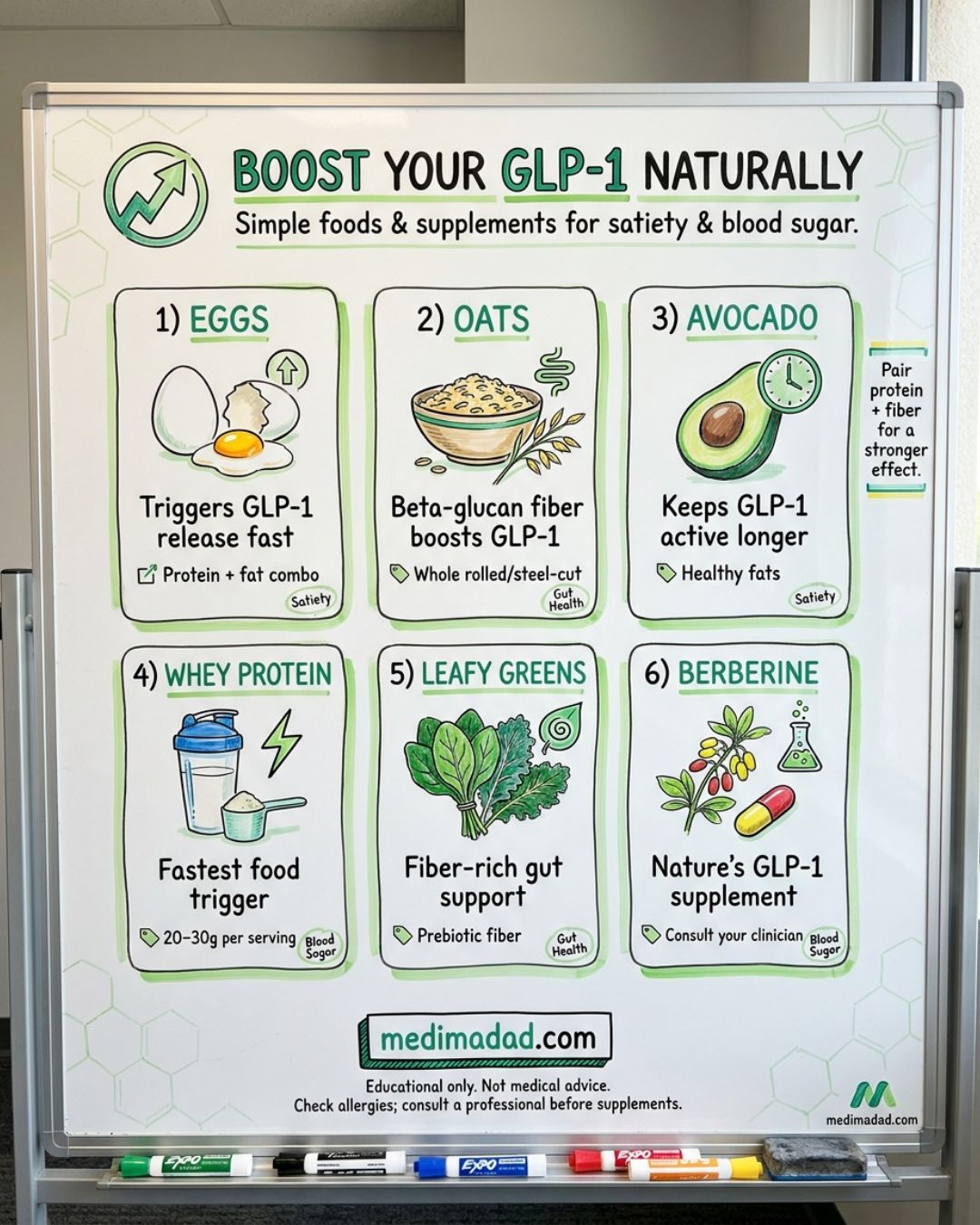
Protein at breakfast. Protein-rich meals stimulate GLP-1 release more than carbohydrate-heavy ones — this is well-established in the nutrition literature, though the exact magnitude varies by study and population rather than being a single fixed number. Two to three eggs, or an equivalent protein source, is a reasonable daily habit with real physiological backing.
Soluble fiber, particularly beta-glucan. The fiber in oats and psyllium slows digestion and has been shown in multiple studies to increase post-meal GLP-1 and improve satiety. This is one of the more consistently replicated findings in this space. If you don’t reliably get enough fiber from food, a psyllium husk supplement is a reasonable, low-risk way to close the gap — available on Amazon India.
Whey protein specifically. Among protein sources, whey tends to produce a faster satiety response, likely through both GLP-1 and other gut hormones acting together. A pre-meal protein shake is a reasonable strategy if you struggle with portion control at meals — a protein isolate supplement is available on Amazon India for people who don’t get enough from food alone.
Monounsaturated fats and leafy greens. Healthy fats (avocado, olive oil) slow gastric emptying, which keeps GLP-1 circulating longer after a meal. Leafy greens contain thylakoids — plant membrane structures with some evidence for stimulating GLP-1 release. Both are sensible additions to a meal for general metabolic health, independent of any specific percentage claim.
Berberine. This is the compound with the most legitimate claim to “acting through a GLP-1-adjacent pathway” — it activates AMPK, a metabolic pathway that overlaps with some effects of GLP-1 therapy, and a systematic review and meta-analysis of randomized controlled trials found real benefits for blood sugar (fasting glucose -0.82 mmol/L, HbA1c -0.63%) and modest weight management (BMI -1.07 kg/m²) in people with type 2 diabetes. It is genuinely one of the better-evidenced natural compounds in this space, not just a marketing claim — available on Amazon India.
What I’d actually tell a patient about expectations
These strategies work through a real mechanism, and I’d genuinely recommend all of them as good general nutrition regardless of GLP-1 relevance. But be honest with yourself about scale: pharmaceutical GLP-1 agonists produce sustained hormone levels far beyond what any combination of diet and supplements can replicate, which is why they produce double-digit percentage weight loss in trials and diet alone typically doesn’t. If you’re using these strategies as a genuine lifestyle foundation — with or without a prescription medication alongside — that’s a reasonable, low-risk approach. If you’re using them because you’re hoping to avoid a conversation with your doctor about whether medication is appropriate for you, that’s worth examining honestly.
A simple daily pattern
Protein-forward breakfast (eggs, or a protein shake if mornings are rushed), a meal built around fiber and healthy fats at lunch, berberine with meals if you and your doctor agree it’s appropriate for you, and leafy greens at dinner. None of this requires precision — consistency matters more than exactness here.
Frequently asked questions
Is berberine as effective as Ozempic?
No — it works through an overlapping but much weaker pathway, and shouldn’t be framed as equivalent. For general metabolic health and modest weight management, especially alongside dietary changes, it has real evidence behind it. For significant weight loss or diabetes management, it isn’t a substitute for prescription GLP-1 therapy.
How long before I’d notice anything?
Most people report modestly reduced appetite within a few weeks of consistent dietary changes. This is a much slower, subtler effect than what GLP-1 medications produce, and expectations should be calibrated accordingly.
Are there side effects to worry about?
The foods here are all ordinary whole foods with established safety profiles. Berberine can cause mild digestive discomfort in some people — starting at a lower dose and increasing gradually helps, and it’s worth checking with your doctor if you’re on other medications, since it can interact with some.
References
Disclosure: This article contains affiliate links. If you purchase through our links, we may earn a small commission at no extra cost to you. We only recommend products we have researched. This article is for educational purposes only and does not constitute medical advice. Always consult a qualified healthcare professional before starting any supplement.
Further Reading
Related on Medimadad
Get free weekly health insights from Dr. Ajit Kumar
Join thousands of readers. No spam. Unsubscribe anytime.
