

Written and reviewed by Dr. Ajit Kumar, MD (Medicine) | MA (Psychology), Founder of Medimadad. Last reviewed: July 2026. This article is for informational purposes only and does not constitute medical advice. Read our Editorial Policy.
Key Takeaways
- Glycemic index (GI) measures how fast a food raises blood sugar — not how much sugar it contains. White rice has a GI of 64–72; roti made from whole wheat flour is 62–70. The difference is smaller than most people expect.
- Cooking method dramatically changes GI: freshly cooked white rice (GI ~72) vs cooled and reheated rice (GI ~53) — cooling creates resistant starch that your body digests more slowly.
- The most powerful GI strategy for Indians is food pairing: adding dal, sabzi, curd, or fat to any rice or roti meal slows absorption significantly, regardless of the grain used.
- Low-GI swaps with the highest real-world impact in Indian diets: brown rice over white, whole wheat roti over maida, moong dal chilla over white bread, and beginning meals with vegetables or salad.
- Glycemic load (GL) — which accounts for portion size — is more useful than GI alone. A small portion of high-GI food may have a lower GL than a large portion of medium-GI food.
India has the world’s largest population of people with Type 2 diabetes — over 100 million — and a rapidly growing pre-diabetic population. Yet most dietary advice given to Indians with blood sugar concerns focuses on avoiding rice and roti entirely, which is neither sustainable nor supported by evidence when you understand how glycemic index and food pairing actually work.
This guide covers the GI of India’s most commonly eaten foods, the practical strategies that lower blood sugar impact without requiring you to abandon your diet, and the specific swaps that make the most difference for Indian eating patterns.
What Is Glycemic Index — and Why Does It Matter?
Glycemic index is a scale from 0 to 100 that ranks how quickly a carbohydrate-containing food raises blood glucose compared to pure glucose (GI = 100). Foods are categorised as:
| Category | GI Range | Examples |
|---|---|---|
| Low GI | 55 or below | Most dal, chickpeas, rajma, barley, oats, most vegetables |
| Medium GI | 56–69 | Whole wheat roti, basmati rice, sweet potato, banana |
| High GI | 70 or above | White rice (freshly cooked), white bread, maida products, glucose drinks |
GI matters because high-GI foods cause rapid blood glucose spikes followed by sharp drops — the pattern that drives insulin resistance over time, contributes to Type 2 diabetes progression, and causes the energy crashes and hunger cycles that make weight management harder.
GI of Common Indian Foods
| Food | GI | Category | Notes |
|---|---|---|---|
| Moong dal | 38 | Low | Best blood sugar impact of all dals |
| Rajma (kidney beans) | 29 | Low | One of the lowest-GI foods in Indian diet |
| Chana dal | 11 | Very Low | Exceptional blood sugar control food |
| Oats (rolled) | 55 | Low | Steel-cut oats are even lower (~42) |
| Basmati rice (cooked) | 58 | Medium | Lower GI than regular white rice; ageing increases this |
| Whole wheat roti | 62 | Medium | Lower than many people assume |
| White rice (freshly cooked) | 72 | High | Cooling reduces this significantly |
| White rice (cooled + reheated) | 53 | Low | Cooling creates resistant starch — significant GI drop |
| Idli (white rice) | 70 | High | Fermentation reduces GI somewhat vs plain rice |
| Dosa (plain) | 77 | High | Pair with sambar + coconut chutney to lower GL |
| Maida / white bread | 70–85 | High | Avoid for blood sugar management |
| Sweet potato (boiled) | 63 | Medium | Much lower than regular potato (GI 78) |
| Potato (boiled) | 78 | High | Cooling reduces GI; eaten with dal significantly lowers GL |
GI of Fruits, Legumes, Dairy, and Other Common Foods
The table above covers grains and staples; the table below extends the same reference-based approach (Atkinson et al., Diabetes Care, 2008 — the same source cited at the end of this article) to fruits, legumes, dairy, and nuts commonly eaten across Indian diets. Where published studies show a real range rather than one fixed number, the range is shown rather than a single manufactured figure.
| Food | GI | Category | Notes |
|---|---|---|---|
| Chana (chickpeas, boiled) | 28–33 | Low | Also called garbanzo/kabuli chana; excellent choice for chaat and curries |
| Green peas (matar, boiled) | 51 | Low-Medium | Higher than most legumes but still a reasonable everyday vegetable |
| Peanuts (moongfali) | 7–23 | Very Low | Fat and protein dominate; among the lowest-GI foods eaten in India |
| Cashews (kaju) | 22–25 | Very Low | Similar profile to peanuts — good low-GI snack in moderation |
| Milk (whole, doodh) | 27–39 | Low | Lactose raises blood sugar less than most sugars due to protein/fat content |
| Curd / plain yogurt (dahi) | 35–41 | Low | Also contains probiotics that may modestly blunt post-meal glucose spikes |
| Apple | 36 | Low | One of the most consistent low-GI fruits across studies |
| Orange | 40–43 | Low | Whole fruit is lower-GI than juice, which lacks the fibre |
| Pear | 38 | Low | Skin-on pear has more fibre and a slightly lower effective GI |
| Carrot (boiled) | 32–49 | Low | Older claims of very high carrot GI came from a since-corrected 1981 study — modern data shows low GI |
| Banana (ripe) | 48–52 | Low-Medium | Rises with ripeness — a greener banana has a meaningfully lower GI |
| Mango | 51–60 | Medium | A common source of confusion — moderate GI, but portion size matters more (GL) |
| Grapes | 53–59 | Medium | Similar range to mango; eat with skin for the fibre |
| Sweet corn (boiled) | 52–60 | Medium | A reasonable grain swap, but portion control still matters |
| Papaya | 56–60 | Medium | Higher than most fruits eaten in India; fine in normal portions |
| Watermelon | 72–80 | High | The classic GI-vs-GL example: high GI, but its water content means a typical serving has a low glycemic load — see the GL section below |
The Biggest GI Insight for Indians: Food Pairing Matters More Than Food Choice
The single most impactful strategy for blood sugar management in an Indian diet is not switching from rice to roti — it is what you eat alongside either. Research consistently shows that combining a high-GI carbohydrate with protein, fat, or fibre from the same meal substantially reduces the overall glycemic response.
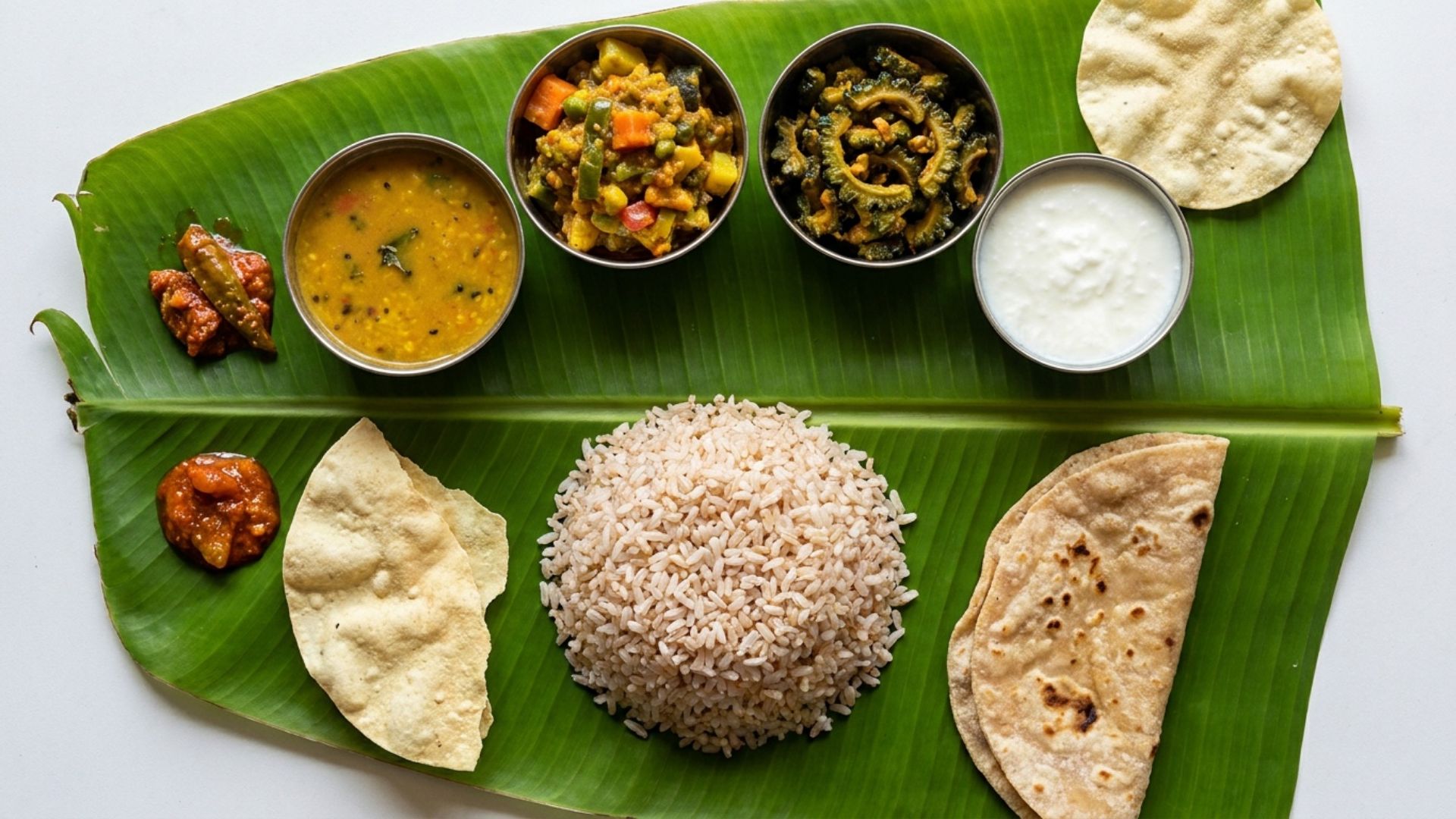
This is why the traditional Indian thali — rice or roti with dal, sabzi, curd, and a small amount of ghee — is genuinely well-suited to blood sugar management when eaten in appropriate portions. The dal provides protein and fibre that slow starch absorption. The ghee slows gastric emptying. The sabzi adds fibre and micronutrients. The curd provides probiotics that may reduce post-meal glucose spikes.
Studies comparing rice eaten alone versus rice eaten as part of a traditional meal show post-meal glucose peaks that are 30–40% lower for the complete meal. The lesson: never eat a high-GI carbohydrate in isolation.
The Cooling Trick: How to Lower Rice GI at Home
One of the most practical and under-appreciated strategies for Indian cooks: cooking rice, allowing it to cool completely (preferably refrigerated for 12–24 hours), then reheating before eating reduces its GI from approximately 72 to 53. This happens because cooling converts some of the digestible starch into resistant starch — a form that behaves more like dietary fibre, feeding gut bacteria rather than spiking blood glucose.
This applies to leftover rice, making yesterday’s rice actually better for blood sugar than freshly cooked rice. The same principle applies to cooked and cooled potatoes — cold potato salad has a significantly lower GI than hot boiled potatoes.
Highest-Impact Swaps for Indian Eating Patterns
- Maida roti/paratha → whole wheat roti: GI drops from ~80 to ~62. Use 100% atta, not maida-blended flour.
- White bread → multigrain or sourdough bread: GI drops from 70–85 to 54–65 depending on the brand.
- Plain white rice → basmati: GI 72 vs 58. Further reduced when eaten with dal.
- Sugar-sweetened chai → unsweetened or jaggery-based: Removes the fasted glucose spike from breakfast.
- Morning poha or upma alone → with eggs or sprouts: Protein addition significantly lowers the glycemic response of the same carbohydrate amount.
- Start meals with vegetables: Eating salad or sabzi before rice/roti reduces peak glucose by 30–40% (confirmed in RCTs on meal sequence).
Bitter Melon (Karela): India’s Best Blood Sugar Vegetable
Karela (bitter melon, Momordica charantia) has been used in Ayurveda for blood sugar management for centuries. Modern research supports this: active compounds including charantin, vicine, and polypeptide-p appear to improve insulin sensitivity and reduce post-meal glucose spikes. Multiple clinical studies in Indian patients with Type 2 diabetes show modest but consistent reductions in fasting blood glucose and HbA1c with regular karela consumption or extract supplementation.
Karela is not a substitute for medication in diagnosed diabetes. But as a dietary addition or supplement, it is one of the best-evidenced Indian-origin blood sugar management tools.
Recommended on Amazon.in
Karela (Bitter Melon) Extract Supplement — Concentrated extract standardised for blood sugar support, well-reviewed by Indian buyers managing blood glucose naturally
This is an affiliate link – we may earn a commission at no extra cost to you. See our Affiliate Disclosure.
“The most common misconception I correct in patients with pre-diabetes or Type 2 diabetes is the belief that they must eliminate rice or roti. This creates unnecessary dietary restriction and poor adherence. The evidence supports a much more practical approach: eat your rice with dal, start your meal with vegetables, and reduce portions — rather than eliminating entire food groups. The cooling trick for rice is something I now mention to every patient who asks about carbohydrates. It is free, requires no behaviour change other than cooking the previous evening, and has real evidence behind it.”
Dr. Ajit Kumar — MD (Medicine) | MA (Psychology) | Founder, Medimadad
Frequently Asked Questions
Is rice bad for blood sugar?
Not inherently, but portion size and context matter enormously. White rice eaten alone has a high GI (~72). The same rice eaten with dal, sabzi, and curd as part of a traditional Indian meal has a significantly lower effective glycemic response due to the protein, fibre, and fat slowing absorption. Basmati rice has a lower GI than standard white rice. Cooled and reheated rice has an even lower GI (~53) due to resistant starch formation. People with diabetes should monitor their individual post-meal glucose response rather than eliminating rice categorically.
Is roti better than rice for diabetics?
Marginally, but not dramatically. Whole wheat roti has a GI of approximately 62 versus white rice at 72 — a meaningful but not transformative difference. The more impactful factor is what you eat alongside either. A roti eaten with ghee, dal, and vegetables will produce a better blood sugar response than the same roti eaten alone. Portion size matters more than the choice between rice and roti.
What is the lowest-GI Indian breakfast?
The lowest-GI Indian breakfast options are: moong dal chilla (GI ~30–40), sprout chaat (GI ~30), or vegetable poha made with flattened brown rice and topped with peanuts (GI ~55 with protein addition). Upma made with semolina has a moderate GI (~66) but is improved by adding vegetables and eating with curd. Plain white idli or dosa eaten alone are high GI — pair them with sambar and coconut chutney to reduce the glycemic impact.
Does ghee raise blood sugar?
No — ghee contains no carbohydrates and does not directly raise blood glucose. In fact, the fat in ghee slows gastric emptying, which means carbohydrates from the same meal are absorbed more slowly, producing a lower and more gradual glucose rise. Traditional use of a small amount of ghee on roti or rice has a physiological basis in blood sugar management. The concern with ghee is caloric density for weight management, not blood sugar directly.
Which dal is best for blood sugar?
Chana dal (Bengal gram) has the lowest GI of all common Indian dals at approximately 11 — exceptionally low. Moong dal (whole) is next at approximately 38. Rajma (kidney beans) has a GI of 29. Toor dal and masoor dal have slightly higher GI values (~42–52) but are still firmly in the low-GI category. All dals are excellent blood sugar foods. The preparation method matters too: whole dal is lower GI than washed and split dal; dal cooked without excessive water and thick in consistency raises blood sugar more slowly than thin, watery preparations.
What is the glycemic index of chana dal?
Chana dal (Bengal gram) has one of the lowest glycemic index values among Indian dals, commonly cited around 11, though international reference tables (Atkinson et al., Diabetes Care, 2008) show a wider measured range of roughly 8 to 36 depending on variety, cooking method, and whether it is whole or split. Even at the higher end of that range, chana dal remains firmly in the low-GI category (55 or below).
What is the glycemic index of moong dal?
Moong dal (whole) has a glycemic index of approximately 38, placing it comfortably in the low-GI range. Split and washed moong dal tends to sit slightly higher than the whole form, consistent with the general pattern that more processed, less intact pulses digest faster.
What is the glycemic index of toor dal?
Toor dal (arhar/pigeon pea) is harder to pin to one exact number — published values range from the low 20s to the low 50s depending on the specific study, variety, and preparation. Across that entire range, though, toor dal is consistently classified as low-to-medium GI, never high, and remains a sound choice for blood sugar management as part of a balanced meal.
What is the glycemic index of maida (refined wheat flour)?
Maida has a high glycemic index, typically measured in the 70 to 85 range — among the highest of any common Indian flour, since the refining process strips out the fiber and bran that would otherwise slow digestion. This is the main reason maida-based foods (naan, white bread, many packaged snacks) raise blood sugar quickly, and why whole wheat atta is the preferred everyday flour for anyone managing blood sugar.
What is the glycemic index of suji (rava/semolina)?
Suji (rava/semolina) has a moderate glycemic index, generally cited around 55 to 66 — meaningfully lower than maida, since it undergoes less intensive refining and retains a bit more fiber and protein. An early Indian study (Mani UV et al., Journal of the American College of Nutrition, 1990) measured a semolina-based preparation at a GI of 66, notably lower than white bread at 75. Suji sits in the medium-GI band rather than the high-GI band maida occupies, though portion size and what it is paired with still matter.
What is glycemic load, and why does it matter more than glycemic index alone?
Glycemic index (GI) only measures how fast a food raises blood sugar per standard serving — it does not account for how much of that food you actually eat. Glycemic load (GL) corrects for this by factoring in real portion size, which is why it is generally the more clinically useful number for everyday meal planning. A practical consequence: a small portion of a high-GI food can have a lower total glycemic load than a large portion of a medium-GI food. This is also why pairing strategies matter so much in Indian meals — a roti or rice portion eaten with dal, sabzi, and curd produces a meaningfully lower glycemic load than the same carbohydrate eaten alone, even though the GI of the rice or roti itself does not change.
Related on Medimadad
References
- Atkinson FS, et al. International tables of glycemic index and glycemic load values: 2008. Diabetes Care. 2008;31(12):2281–2283.
- Nishi SK, et al. Effect of meal sequence on postprandial glycemia. Eur J Clin Nutr. 2016;70(2):197–201.
- Higgins JA. Resistant starch and energy balance: impact on weight loss and maintenance. Crit Rev Food Sci Nutr. 2014;54(9):1158–1166.
- Srivastava Y, et al. Antidiabetic and adaptogenic properties of Momordica charantia extract: an experimental and clinical evaluation. Phytother Res. 1993;7(4):285–289.
- Imai S, et al. Eating vegetables before carbohydrates improves postprandial glucose excursions. Diabet Med. 2013;30(3):370–372.
Related on Medimadad
Free Guide: Understanding Your Numbers
All 7 Weight Management calculators — BMI, calorie needs, ideal body weight, protein, water, waist-to-height ratio, and body fat — explained in one place, with what each number actually means and how they fit together.
Get free weekly health insights from Dr. Ajit Kumar
Join thousands of readers. No spam. Unsubscribe anytime.
