
By Dr. Ajit Kumar, MD Medicine — Healthcare Consultant and Health Educator, Founder of Medimadad. About the Author | Editorial Policy
India is facing a protein crisis that most people do not know they are part of. A nationwide survey of 1,800 Indian households found that 93% of respondents consumed less protein than recommended – and 73% had no idea that protein deficiency was even a concern. This is not a problem of poverty alone: protein deficiency spans all income brackets and urban-rural divides.
What the Official Numbers Say – and Why They Are Likely Too Low
The Indian Council of Medical Research (ICMR) sets the Recommended Dietary Allowance (RDA) for protein at 0.8g per kilogram of body weight per day for sedentary adults. For a 60kg person, that is 48g of protein daily.
However, this number comes with important caveats that are rarely communicated to the public:
- The RDA is a minimum – the amount needed to prevent deficiency, not the amount needed to optimise health
- It is based on nitrogen balance studies that assume highly digestible animal protein, not the plant-heavy Indian diet
- It does not account for aging (protein needs increase significantly after 60), physical activity, illness, or recovery
- Newer research consistently suggests that 1.2-1.6g/kg/day is closer to the optimal intake for most adults
A comprehensive 2023 review in Nutrients concluded that the RDA for protein is likely 30-50% too low for most adults when health optimisation – rather than mere survival – is the goal.
How Much Protein Are Indians Actually Eating?
The National Nutrition Monitoring Bureau (NNMB) and the Comprehensive National Nutrition Survey provide the clearest picture. The data is concerning:
| Population Group | Average Daily Protein Intake | ICMR RDA | Gap |
|---|---|---|---|
| Urban adult male | ~55g/day | 60g/day | Mild deficit |
| Urban adult female | ~45g/day | 50g/day | Moderate deficit |
| Rural adult male | ~42g/day | 60g/day | Significant deficit |
| Rural adult female | ~35g/day | 50g/day | Severe deficit |
These numbers only compare to the minimum RDA. Against the optimal intake of 1.2-1.6g/kg, virtually all groups are significantly deficient.
Why the Indian Diet Falls Short on Protein
1. Calorie-Dense, Protein-Sparse Staples
The Indian dietary backbone – rice, roti, and dal – is dominated by carbohydrates. A typical meal of 2 rotis, half a cup of dal, and rice provides roughly 15-20g protein for 500-600 calories. The protein-to-calorie ratio is poor. You would need to eat an enormous amount of food to meet protein needs from these staples alone.
2. Dal Is Not as Protein-Rich as People Believe
Cooked dal (lentils) contains roughly 7-9g protein per cup. To get 60g of protein from dal alone, you would need to eat 7 cups of cooked dal daily – roughly 1,800 calories from dal alone. This is neither practical nor palatable. Dal is a valuable protein source but it cannot carry the full load of protein requirements.
3. Plant Proteins Have Lower Digestibility
Not all dietary protein is equally absorbed. Protein quality is measured by DIAAS (Digestible Indispensable Amino Acid Score):
- Whey protein: DIAAS ~1.25 (complete, highly digestible)
- Eggs: DIAAS ~1.13 (complete, excellent digestibility)
- Milk: DIAAS ~1.18
- Chicken breast: DIAAS ~1.08
- Lentils (dal): DIAAS ~0.59 (incomplete amino acid profile, lower digestibility)
- Wheat (roti): DIAAS ~0.45 (low quality, low digestibility)
This means that to get the same usable protein, you need to consume significantly more plant-source protein than animal-source protein. A vegetarian diet can absolutely meet protein needs, but it requires deliberate food combining and higher total intake.
4. Vegetarianism Without Dairy Planning
India's predominantly vegetarian diet can be protein-adequate if it includes significant dairy (paneer, curd, milk) and legumes. But many Indians eat very little paneer (cost), limited curd, and skip eggs for religious reasons. This leaves the diet critically short of complete protein.
How to Actually Meet Protein Needs on an Indian Diet
For Vegetarians
Dal is lysine-rich but low in methionine. Rice and wheat are methionine-rich but low in lysine. Together, they form a complete amino acid profile. This is why dal-chawal has sustained Indian populations – it is nutritionally complementary, just not calorie-efficient for protein.
100g paneer provides ~18g high-quality protein with a DIAAS close to 1.0. 200g curd (dahi) provides ~7g. A lunch with 100g paneer and dinner with curd can add 25g quality protein. This is the most practical protein boost for vegetarians.
Soya is the only plant food with a DIAAS above 1.0 (complete protein). Soya milk, tofu, and soya chunks (nutrela) are inexpensive and protein-dense. 100g dry soya chunks provide ~52g protein. Adding 30-50g soya chunks to a curry adds ~15-25g protein.
One scoop of whey protein (25-30g protein, ~120 calories) taken with breakfast or as a snack is the most efficient way to close the protein gap. It is a dairy-derived food, acceptable to most vegetarians, and substantially cheaper per gram of protein than most food sources.
For Non-Vegetarians
The protein equation is much simpler but still requires awareness:
- Eggs – 6g protein per egg, DIAAS 1.13. 3 eggs = 18g quality protein for minimal cost. The most efficient Indian non-vegetarian protein source
- Chicken breast – 31g protein per 100g cooked. A 150g serving = ~45g protein. Two such servings with eggs could meet the full daily protein target
- Fish (rohu, catla, mackerel, sardines) – 20-25g protein per 100g cooked. Also provides omega-3 – a double nutritional benefit
- Mutton/goat meat – ~27g protein per 100g. Culturally common but expensive daily. Best consumed 3-4x per week
Protein Needs Across Life Stages
| Life Stage | Recommended Intake | Why Higher |
|---|---|---|
| Children (4-13 years) | 0.95-1.1g/kg/day | Rapid growth |
| Adolescents (14-18 years) | 1.2-1.5g/kg/day | Growth + muscle development |
| Active adults (19-60) | 1.2-1.6g/kg/day | Muscle maintenance |
| Pregnant women | +25g/day above baseline | Fetal development |
| Breastfeeding | +20g/day above baseline | Milk production |
| Adults over 60 | 1.2-2.0g/kg/day | Sarcopenia prevention – anabolic resistance means more protein needed for same muscle-building effect |
The elderly requirement is particularly overlooked in India. Sarcopenia – age-related muscle loss – is epidemic among older Indians and is directly linked to insufficient protein intake. Falls, frailty, and loss of independence are the real-world consequences.
Signs You Are Not Eating Enough Protein
- Persistent fatigue and low energy despite adequate sleep
- Slow wound healing or frequent infections (protein is essential for immune function)
- Hair thinning or hair loss (keratin is a protein)
- Brittle nails
- Muscle weakness or difficulty building muscle despite exercise
- Swelling in hands or feet (severe deficiency causes oedema via low albumin)
- Constant hunger even after large meals (protein is the most satiating macronutrient)
Dr. Ajit Kumar's Clinical Perspective
“Protein deficiency is one of the most underdiagnosed nutritional problems in India, especially among middle-class urban adults who consider their diet 'balanced.' The numbers are usually the surprise – a breakfast of poha or upma, lunch of 2 rotis and sabzi, and dinner of dal rice can add up to just 35-40g protein for a 65kg adult who needs at least 52g at minimum. The easiest changes: add 2 eggs at breakfast and shift to a curd-heavy diet. For vegetarians who cannot use eggs, whey protein is the most practical, evidence-backed solution.”
– Dr. Ajit Kumar, MD Medicine | Healthcare Consultant and Health Educator, Founder of Medimadad
A Sample High-Protein Indian Meal Plan
Target: 70kg adult, 84g protein (1.2g/kg) – Vegetarian
- Breakfast: 1 cup milk (8g) + 30g whey protein shake (25g) + 1 bowl poha with peanuts (5g) = 38g
- Lunch: 1 cup dal (9g) + 100g paneer sabzi (18g) + 2 rotis (5g) = 32g
- Snack: 150g curd (dahi) (5g) = 5g
- Dinner: 1 cup rajma/chole (12g) + 1 cup rice (4g) = 16g
- Total: ~91g protein ✓
Frequently Asked Questions
Is it true that eating too much protein damages the kidneys?
In people with healthy kidneys, there is no good evidence that high protein intake (up to 2g/kg/day) causes kidney damage. This myth persists from older research in people who already had kidney disease – in whom high protein intake does worsen progression. For healthy people, kidneys handle higher protein loads without difficulty. If you have known kidney disease, discuss protein intake with your nephrologist.
Can I get enough protein from a purely vegetarian Indian diet without supplements?
Yes, but it requires deliberate effort. A vegetarian diet meeting 1.2g/kg/day needs to include significant quantities of paneer, curd, soya, dal, and ideally eggs (lacto-ovo vegetarians). Strictly vegan diets in the Indian context are at serious risk of protein shortfall without supplementation.
Is dal enough for protein?
No, not as a sole protein source. While dal is valuable, it is incomplete in amino acids and has moderate digestibility. It should be combined with other protein sources (grains for complementary amino acids, dairy for completeness) and is most effective as part of a diverse protein strategy.
When is the best time to eat protein?
Total daily protein matters more than timing for most people. However, for muscle building and preservation, distributing protein across 3-4 meals (20-30g per meal) is more effective than consuming most protein in one meal. The body can only efficiently use roughly 25-40g of protein for muscle synthesis at one time.
Is whey protein safe for Indians to use long-term?
Yes. Whey protein is derived from dairy and is safe for long-term daily use in people with healthy kidneys and no dairy allergy or lactose intolerance. It is not a steroid or an anabolic drug – it is simply a concentrated, convenient food protein. Choose products tested for quality (look for Informed Sport or NSF certification for supplements).
Further Reading
- → Vitamin D Deficiency in India: How Bad Is It Really – and How to Fix It
- → Mediterranean Diet vs Indian Diet: Which Is Better for Heart Health?
- → Ashwagandha vs Creatine for Stress and Cognitive Performance: What the Research Actually Shows
- → 7 Signs You Have a Magnesium Deficiency – And How to Fix It on an Indian Diet
- → Best Time to Take Omega-3 for Maximum Absorption – The Science Explained
- → The Hidden Dangers of Ultra-Processed Foods for the Indian Brain
- → Calculate Your Exact Daily Protein Requirement →
- → Low Glycemic Index Foods for Indian Meals: The Complete Guide
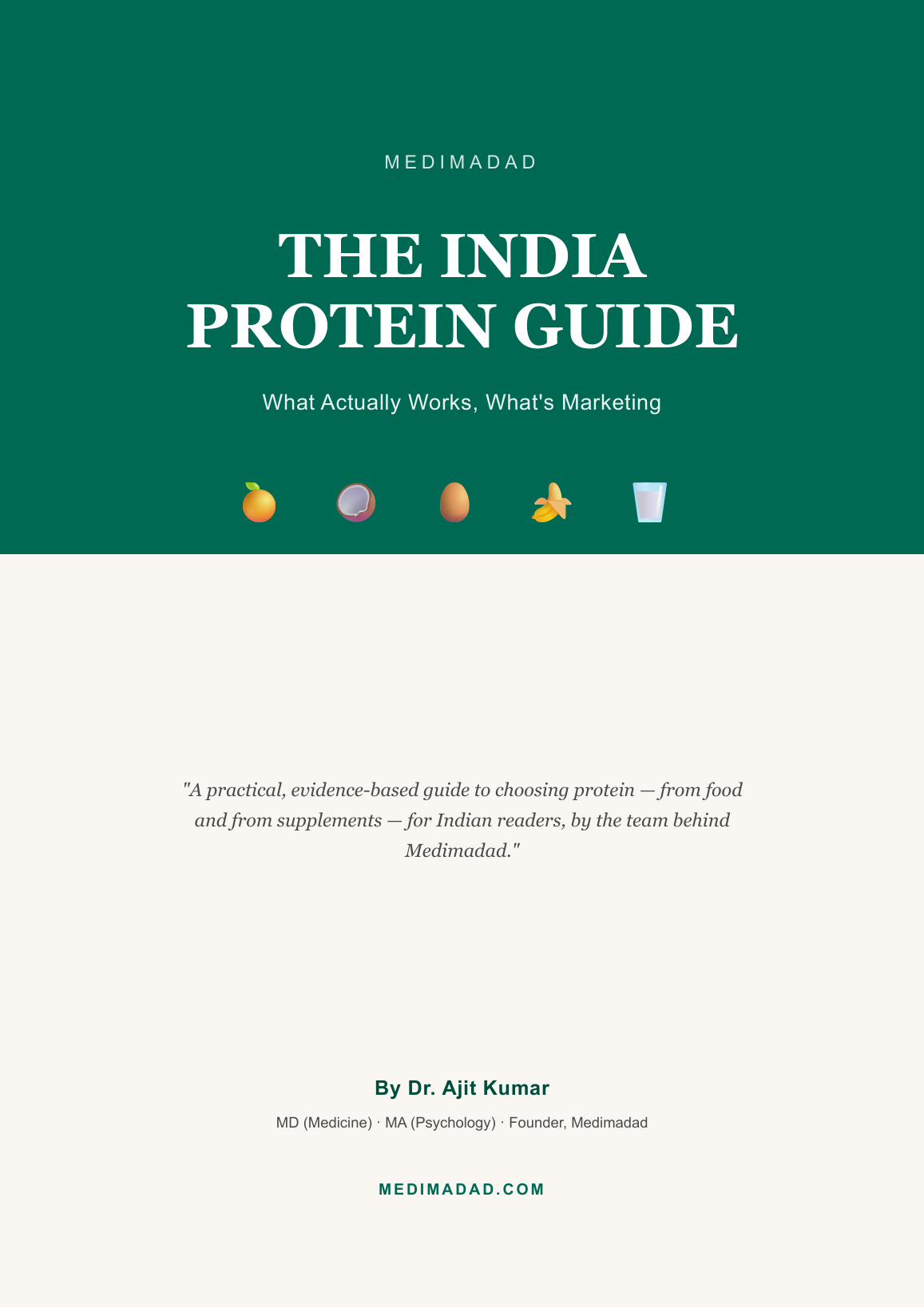
Free eBook: The India Protein Guide
Turn these numbers into a shopping list.
The India Protein Guide is a free 29-page eBook by Dr. Ajit Kumar: how to meet your protein target with Indian foods and supplements, how to read a label, and a practical grocery checklist.
Get free weekly health insights
Join thousands of readers. No spam. Unsubscribe anytime.
