
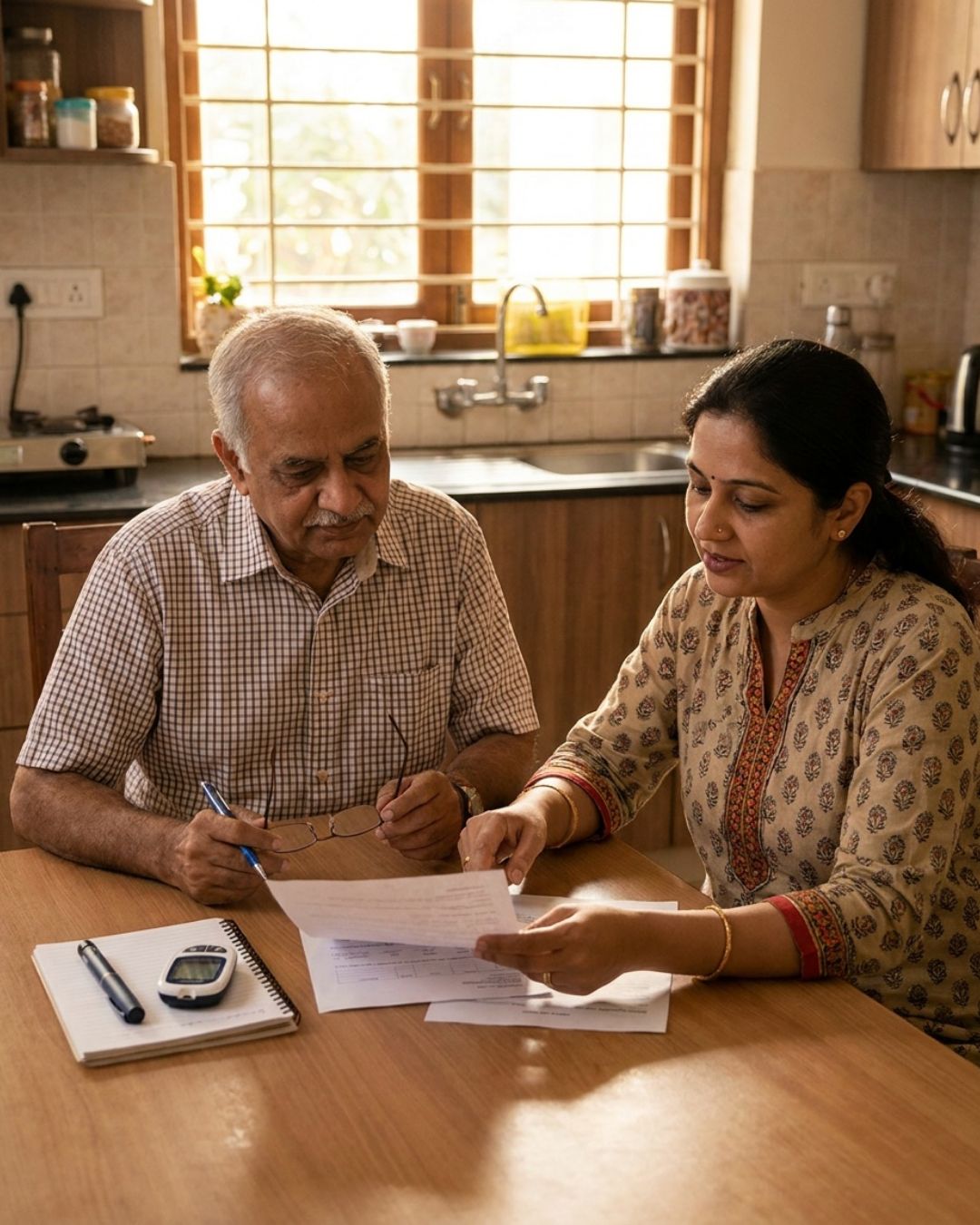

A diabetes diagnosis arrives as a medical fact first — a blood sugar number, a doctor’s explanation, a new set of habits to build. What usually doesn’t arrive at the same time is any real sense of what managing it will actually cost, not just this year, but for the next twenty or thirty.
That gap matters. Diabetes is one of the few chronic conditions where the financial burden is large enough, and sustained enough, to genuinely change a family’s financial trajectory — and the research on this, while it varies by study and region, is consistent on the scale of the problem.
What the Real Numbers Show
A pan-India study (Nagarathna et al., published via PMC) put average annual type-2-diabetes care expenditure at roughly ₹14,000, and separately estimated lifetime medication-management cost alone — not counting complications, hospitalizations, or monitoring supplies — at approximately ₹19,45,135.
A separate nationally representative survey found that around 38% of Indian households with a diabetic member experience what researchers call “catastrophic health expenditure” — health spending that crosses roughly 10% of the household’s total spending capacity. About 10% of those households are pushed below the poverty line specifically because of diabetes-related out-of-pocket costs.
A regional household-level study from Northern India found a somewhat lower figure: around ₹17,113 in annual per-person cost, of which ₹10,424 was paid out-of-pocket rather than covered by insurance. The gap between studies reflects real differences in region, methodology, and what’s counted — not a contradiction to resolve, but a reminder that “the cost of diabetes” is a range shaped by where you live, what complications develop, and how well the condition is managed, not a single fixed number.
Where the Money Actually Goes
- Medication — the largest recurring line item for most people, compounding over decades rather than being a one-time cost.
- Monitoring supplies — glucose test strips, and increasingly continuous glucose monitors, are an ongoing cost many people underestimate when budgeting only for doctor visits and medicine.
- Routine check-ups and lab work — periodic HbA1c testing, kidney function tests, and eye exams are recommended specifically because catching problems early is dramatically cheaper than treating them late.
- Complications — the single largest cost multiplier. Poorly managed diabetes over years raises the risk of kidney disease (up to dialysis), diabetic retinopathy, cardiovascular disease, and nerve damage that can lead to amputation — each of which costs vastly more to treat than the diabetes management that could have prevented or delayed it.
Why Early, Consistent Management Is Also a Financial Decision
This is the part that gets lost when diabetes is framed purely as a medical issue: the financial case for consistent management is just as strong as the medical one. A well-controlled diabetic managing the condition with medication, diet, and regular monitoring faces a materially different lifetime cost trajectory than someone whose diabetes goes poorly managed for years before complications force expensive interventions. The ₹19+ lakh lifetime medication estimate above doesn’t include a single hospitalization for a complication — and complications are where costs escalate fastest.
What This Means for Financial Planning
- Check what your health insurance actually covers for a pre-existing condition. Many policies apply a waiting period before diabetes-related claims are covered — know the exact terms before you need them, not after.
- Budget for monitoring supplies as a recurring line item, not an afterthought. Test strips and routine labs add up over a year in a way that’s easy to underestimate when only accounting for medication and doctor visits.
- Treat annual complication screening as cost-saving, not optional. An eye exam or kidney function test is inexpensive compared to treating retinopathy or kidney failure after the fact.
- If a family member has been newly diagnosed, budget conservatively. Given how widely the research shows costs can vary, planning toward the higher end of a realistic range is safer than assuming the lowest figure you’ve seen will apply to your situation.
“Families usually plan for the medical side of a diabetes diagnosis and get blindsided by the financial side years later — often right when a complication shows up. The single most protective thing anyone can do, financially as much as medically, is treat consistent management as non-negotiable from day one. It’s dramatically cheaper than the alternative, and that’s true whether you’re looking at it as a doctor or as a household budget.”
– Dr. Ajit Kumar, MD Medicine | Healthcare Consultant and Health Educator, Founder of Medimadad
Frequently Asked Questions
Is ₹19,45,135 the total lifetime cost of diabetes?
No — that figure, from a pan-India study, covers lifetime medication management specifically. It doesn’t include monitoring supplies, routine check-ups, or the cost of any complications, which is why real lifetime cost varies so widely and can run considerably higher.
Why do different studies show such different numbers?
Region, methodology, and what’s included all vary. A Northern India regional study found roughly ₹17,113 in annual per-person cost; the pan-India figures are higher for lifetime medication alone. Treat these as a realistic range, not a single settled number.
Does good management actually reduce the total cost, or just delay it?
It genuinely reduces it. Complications — not baseline medication — are the largest cost driver, and consistent management measurably lowers complication risk over time rather than merely postponing the same expense.
What’s the single most cost-effective thing a newly diagnosed person can do?
Stay consistent with monitoring and routine complication screening. Catching a problem early is consistently far cheaper than treating it after it’s progressed.
Explore the Wider Medimadad Ecosystem
This is the financial half of a subject Medimadad has already covered in depth from the clinical side. If you want the medical detail behind managing diabetes itself, see our coverage on whether type 2 diabetes can actually be reversed, reversing pre-diabetes with daily habits, common diabetes myths doctors wish people would stop believing, and how diabetes affects erectile function. If insurance and claims are the part that concerns you most, Medimadad Health Finance covers the practical side of navigating coverage and costs in more depth.