
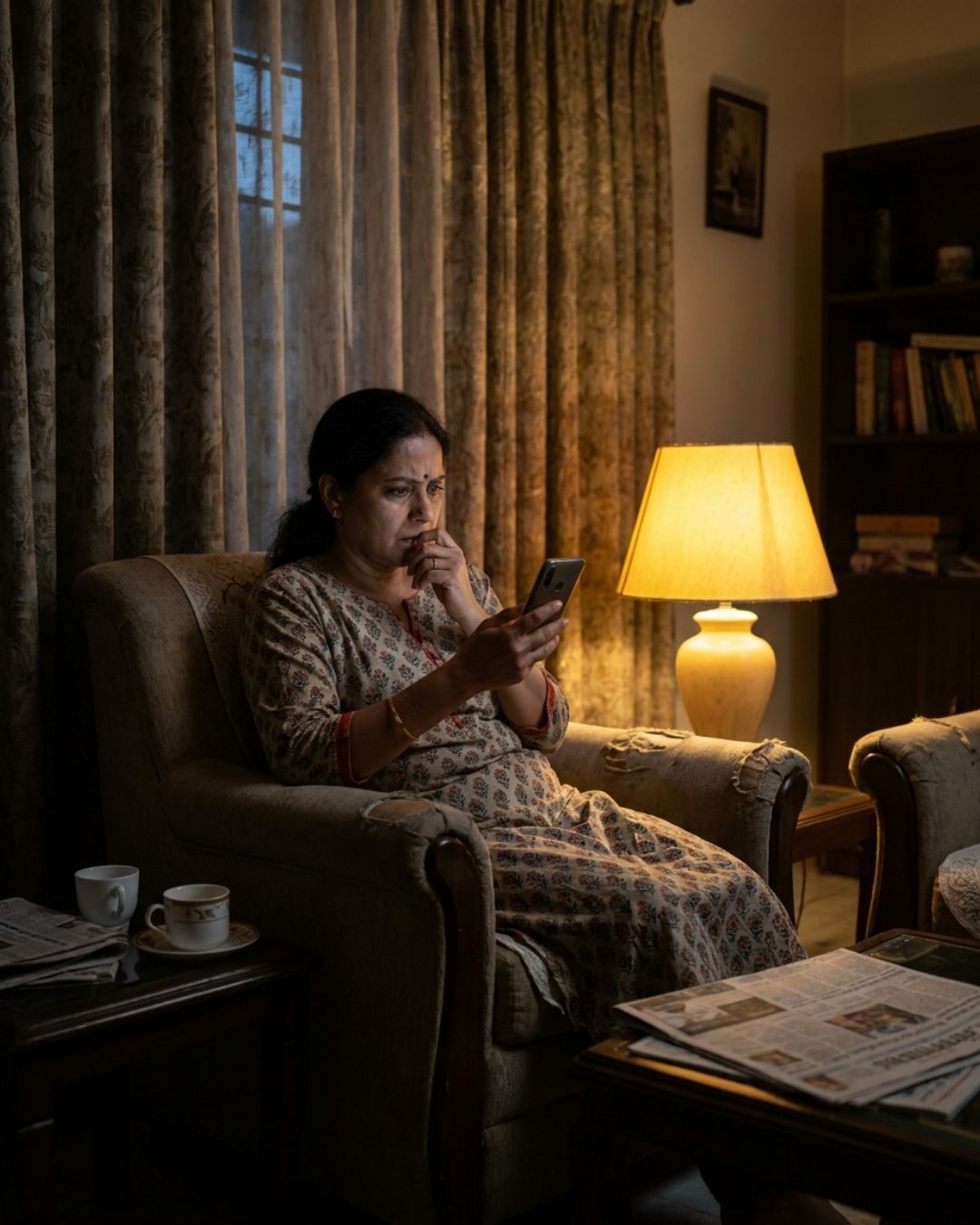

Your phone rings. It’s your son. His voice is shaking, panicked, apologizing — he’s been in an accident, or arrested, or he’s lost his wallet in another city and needs money transferred right now, before he can explain more. It sounds exactly like him. The pauses are right. The way he says “Mum” is right.
It isn’t him. It’s three to four seconds of his voice, pulled from a birthday video or an Instagram Reel, run through an AI voice-cloning tool that needs almost nothing to work.
How Little It Actually Takes
Research cited by cybersecurity firm McAfee found that just three to four seconds of audio is enough to clone a voice with around 85% accuracy. A birthday call, a wedding video, a voice note forwarded in a family WhatsApp group — any of these is more than enough raw material. The tools that do this are not underground or hard to find; several are free, publicly available, and require no technical skill to operate.
The Scale of This in India Right Now
This isn’t a rare, isolated tactic. India’s Indian Cyber Crime Coordination Centre recorded ₹19,813 crore lost to fraud in 2025, and CERT-In (India’s Computer Emergency Response Team) has flagged AI voice-cloning as one of the fastest-growing fraud vectors in its advisories. Meta has separately named India the second most-targeted country globally for cyberscams.
Survey data cited by fraud-prevention researchers found that roughly 1 in 5 people in India report having experienced an attempted AI voice-clone scam, and among those who fell for it, 83% suffered a real monetary loss — nearly half of them losing more than ₹50,000 in a single incident.
This Has Already Happened to Real People
A Mumbai-based doctor lost ₹7 lakh after a deepfake Instagram Reel using Mukesh Ambani’s likeness promoted a fraudulent trading scheme. Deepfake videos impersonating Sudha Murty and a well-known India Today news anchor have been used to push fake investment schemes. These aren’t hypothetical warnings — they’re recent, documented incidents with real financial damage.
Why Parents and Elderly Family Members Are Especially at Risk
The scam works by manufacturing panic faster than the target can think clearly, and elderly family members are frequently the specific target — for a combination of reasons that have little to do with intelligence and everything to do with circumstance:
- They are less likely to have encountered AI voice-cloning as a concept, so the idea that a voice can be faked convincingly doesn’t occur to them as a possibility in the moment.
- They are often reachable alone during the day, without another family member nearby to pause and say “wait, let’s check this.”
- The emotional trigger — a child or grandchild supposedly in danger — is specifically designed to override careful thinking, and it’s most effective on the person who loves that “child” the most.
How to Actually Protect Your Family
Generic advice like “be careful” doesn’t hold up against a voice that sounds completely real. What actually works is having a system in place before you need it:
- Agree on a family verification phrase. A word or short phrase that isn’t posted anywhere online, that every close family member knows, and that a caller has to say before any request for money is taken seriously — even if the voice sounds exactly right.
- Always call back on a known number. Not the number that called you — hang up, and call the person directly on the number already saved in your phone. A scammer on the original line can’t intercept that second call.
- Treat urgency itself as the red flag. Real emergencies rarely require an instant, unverifiable bank transfer with no time to think. The pressure to act immediately, without checking, is the tactic — not a side effect of a real crisis.
- Don’t trust caller ID. Caller ID can be spoofed to show a real, familiar number. It proves nothing on its own.
- Talk to elderly parents about this specifically, in advance. Not as a vague “watch out for scams” comment, but as a concrete example: “If you ever get a call from me sounding panicked and asking for money urgently, hang up and call me back on this number first — every time, no exceptions.”
“The families who handle this well aren’t the ones who are naturally more suspicious — they’re the ones who agreed on a verification system before they needed it. Once panic sets in, careful thinking is exactly what a scammer is counting on you not having time for. A five-minute conversation with your parents now is worth more than any amount of caution in the moment.”
– Dr. Ajit Kumar, MD Medicine | Healthcare Consultant and Health Educator, Founder of Medimadad
If It’s Already Happened to You
Report it immediately to India’s National Cyber Crime Reporting Portal at cybercrime.gov.in, or call the 1930 helpline. Acting within the first few hours meaningfully improves the chance of freezing a fraudulent transaction before the money moves further.
Frequently Asked Questions
How much audio does someone actually need to clone a voice?
As little as three to four seconds, according to research cited by McAfee — enough to reach roughly 85% accuracy. A single public video or voice note is more than sufficient raw material.
Is this only a risk for wealthy families?
No. Reported losses in India range widely, and the targeting is based on who’s reachable and who seems likely to react with panic — not on visible wealth.
Can I tell an AI-cloned voice apart from a real one by listening carefully?
Not reliably. Current voice-cloning quality is good enough that careful listening alone is not a dependable defense — a verification system (a phrase, a callback) is what actually holds up, not trying to detect the fake by ear.
What’s the single most important thing to do right now?
Have the verification-phrase conversation with your closest family members, especially elderly parents, before you ever need it. It takes five minutes and it’s the one thing that works regardless of how convincing the voice sounds.
Explore the Wider Medimadad Ecosystem
Protecting your family from a scam like this isn’t just a technology question — it touches the same ground as financial security and family wellbeing that Medimadad covers more broadly. If the financial-loss side of this concerns you, Medimadad Health Finance covers the practical side of protecting your family’s money as you plan for the future. If it’s the fear and trust side that stays with you — how scams like this affect family relationships and peace of mind — that’s exactly the ground Medimadad Mind & Meanings explores. And for more on AI’s real-world impact, good and concerning, AI Advancements 360 is where we track it in depth.
