

By Dr. Ajit Kumar, MD (Medicine) — Founder, Medimadad. About the Author | Editorial Policy
The Origin of the Anabolic Window Myth
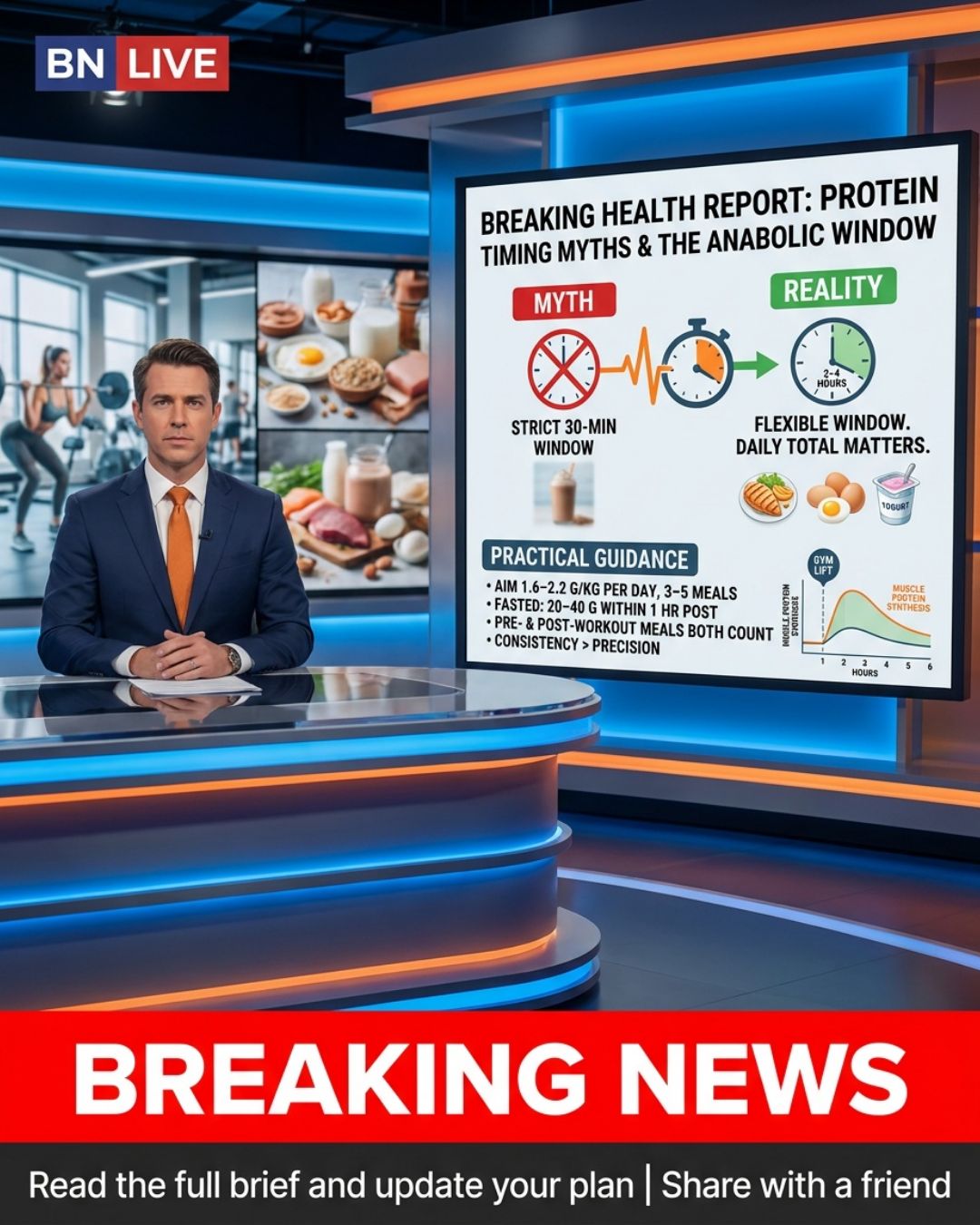
The anabolic window concept grew from early studies in the 1990s and early 2000s showing that protein or amino acid ingestion immediately following resistance exercise produced greater muscle protein synthesis (MPS) responses than no protein at all. This was interpreted — and then heavily commercialised — as meaning that the post-workout period is critically narrow and that missing this window would significantly impair muscle growth.
The problem: these early studies typically used fasted participants who had eaten nothing for several hours before training. The protein consumed post-workout was simply ending a prolonged fast — not exploiting a uniquely potent anabolic window. When researchers began comparing fed versus fasted training conditions and varied the timing of protein intake more systematically, the picture changed substantially.
What Modern Research Actually Shows
The Window Is 4-6 Hours, Not 30 Minutes
A landmark 2013 review by Alan Aragon and Brad Schoenfeld in the Journal of the International Society of Sports Nutrition concluded that the practical anabolic window for protein consumption around resistance training is considerably wider than previously believed — likely 4-6 hours centred around the training session. If you ate a protein-containing meal 1-2 hours before training, your post-workout window extends significantly because the pre-workout meal is still supplying amino acids to your muscles during and after the session.
Total Daily Protein Trumps Timing
A comprehensive 2013 meta-analysis by Schoenfeld, Aragon, and Krieger — which pooled data from 22 studies — found that after controlling for total daily protein intake, protein timing had no statistically significant effect on muscle hypertrophy. In other words, people who hit their daily protein targets showed similar muscle gains regardless of when they consumed that protein relative to training.
This does not mean timing is entirely irrelevant — it means it is a secondary consideration that matters only after total intake is optimised.
Protein Distribution Matters More
While the 30-minute post-workout window is largely a myth, research does support optimal protein distribution across the day. Studies consistently show that spreading protein intake across 3-4 meals of 25-40 g each produces better muscle protein synthesis responses than the same total protein consumed in one or two large doses. The reason: muscle protein synthesis has a per-meal ceiling. Consuming 60 g of protein in a single sitting does not produce twice the MPS response of 30 g — the excess is oxidised or converted to energy. Hitting 30-40 g of protein per meal, three to four times per day, is a more effective strategy than three large doses.
The One Timing Recommendation That Does Hold Up: Pre-Sleep Protein
While post-workout timing has been largely debunked, pre-sleep protein has emerged from rigorous research as genuinely beneficial. A series of studies by Luc van Loon at Maastricht University found that consuming 30-40 g of casein protein (a slow-digesting protein) before sleep significantly increased overnight muscle protein synthesis and improved muscle mass and strength gains in both younger and older adults over weeks of study.
The mechanism makes sense: during the overnight fast, muscle protein synthesis is limited by amino acid availability. Providing a slow-digesting protein source before bed maintains elevated amino acid levels through the night, supporting continuous muscle repair and building. For older adults particularly — who have attenuated MPS responses to protein — pre-sleep protein represents one of the most well-supported practical nutrition interventions available.
How Much Protein Do You Actually Need?
Current evidence-based recommendations for muscle maintenance and growth:
- Sedentary adults: 0.8 g per kg of body weight (the official RDA — widely considered a minimum, not an optimal)
- Active adults: 1.4-1.6 g per kg of body weight
- Resistance-trained athletes or those actively trying to build muscle: 1.6-2.2 g per kg of body weight
- Adults over 60: 1.6-2.0 g per kg of body weight (older muscle is less sensitive to amino acids; higher intake compensates)
- During weight loss on a caloric deficit: Up to 2.2-2.4 g per kg to preserve muscle mass
For an 80 kg Indian man who exercises regularly, this means targeting approximately 128-176 g of protein per day — a target most Indians fall significantly short of.
Best Protein Sources for Indian Diets
Complete protein sources providing all essential amino acids:
- Paneer: ~18 g protein per 100 g — one of the most convenient complete dairy proteins available in India
- Eggs: ~6 g per egg — the gold standard reference protein for bioavailability
- Dal + rice combination: Complements amino acid profiles; 1 cup cooked dal + 1 cup rice provides ~15-18 g complete protein
- Chicken breast: ~31 g per 100 g cooked — the most protein-dense common food
- Greek yoghurt: ~10 g per 100 g — also provides casein, making it useful as a pre-sleep protein source
This is an affiliate link – we may earn a commission at no extra cost to you. See our Affiliate Disclosure.
Expert Perspective
“Protein under-eating is consistently common — across all age groups, but particularly in older adults and women. The anabolic window fixation has been a distraction from the real issue, which is that most people are not hitting even the minimum protein requirements for their activity level. Fix total daily intake first, distribute it reasonably across meals, and add pre-sleep protein if you are serious about muscle maintenance. That is the hierarchy.”
Important Caveats
- Very high protein intakes (above 3 g per kg per day) have not shown additional muscle-building benefits and may stress the kidneys in those with pre-existing renal conditions
- Protein quality matters: plant proteins generally have lower bioavailability and incomplete amino acid profiles; vegetarians should target the higher end of protein recommendations and combine sources strategically
- Pre-sleep casein protein benefits are most pronounced when total daily protein targets are already being met
Frequently Asked Questions
Does it matter when I eat protein after a workout?
Less than previously believed. If you ate protein in the 1-2 hours before training, your post-workout window extends considerably. The practical recommendation: eat a protein-containing meal within 2 hours of finishing your workout, but do not stress over missing a 30-minute window.
Is pre-workout or post-workout protein better?
Neither is definitively superior. A pre-workout protein meal (1-2 hours before training) and a post-workout meal (within 1-2 hours after) are both effective. The key is that protein is present in your system during and after the training session.
Can you absorb more than 30 g of protein per meal?
The body can absorb any amount of protein — absorption is not the limiting factor. The relevant ceiling is for muscle protein synthesis stimulation per meal, which plateaus at approximately 30-40 g for younger adults. Additional protein is not wasted but is used for other metabolic purposes.
Is protein timing more important for older adults?
Yes, relatively. Older adults experience “anabolic resistance” — a blunted muscle protein synthesis response to protein. To compensate, older adults benefit more from ensuring a meaningful protein dose (30-40 g) at each meal, including breakfast, which is typically the most protein-deficient meal in Indian diets.
Related: The Complete Creatine Dosage Guide | How to Build Muscle After 50 | Longevity and Anti-Aging Science Guide | Protein Requirement Calculator
Free eBook: The India Protein Guide
Deciding what protein to actually buy?
The India Protein Guide is a free 29-page eBook by Dr. Ajit Kumar: whey vs. plant protein, how to read a label step by step, and what independent testing found in Indian products.
Free Guide: Understanding Your Numbers
All 7 Weight Management calculators — BMI, calorie needs, ideal body weight, protein, water, waist-to-height ratio, and body fat — explained in one place, with what each number actually means and how they fit together.
Get free weekly health insights from Dr. Ajit Kumar
Join thousands of readers. No spam. Unsubscribe anytime.
