
Written and reviewed by Dr. Ajit Kumar, MD (Medicine) | MA (Psychology), Founder of Medimadad. Last reviewed: August 2026. This article is for informational purposes only and does not constitute medical advice. Read our Editorial Policy.
By Dr. Ajit Kumar — MD (Medicine) | MA (Psychology)
Published: August 2026 | Read time: 6 minutes
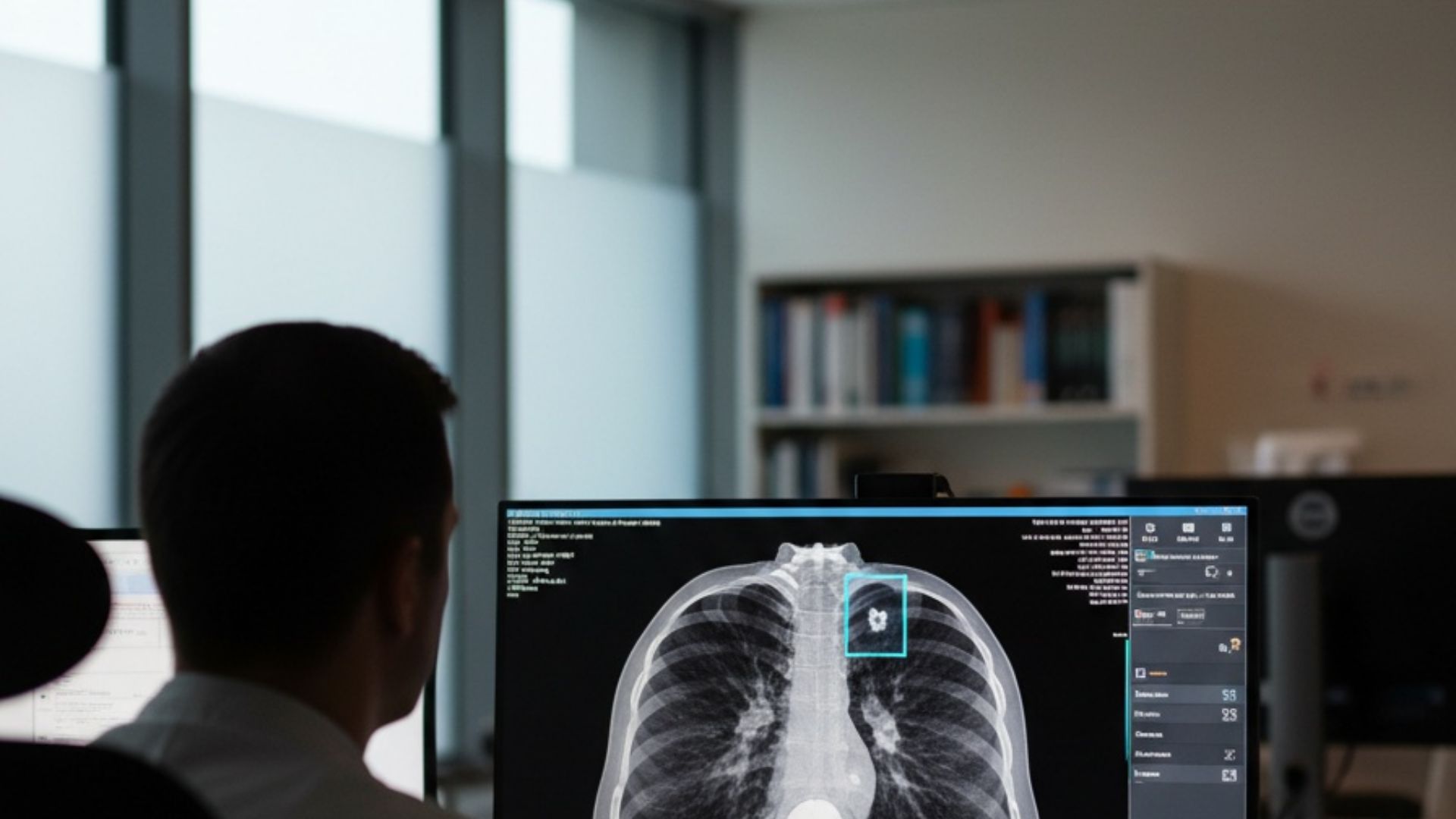
If you’ve had an X-ray, CT, MRI, or mammogram in the last few years, there is a real chance an AI system already looked at it before — or alongside — your radiologist. This isn’t a future scenario. As of March 2026, the U.S. FDA’s AI-Enabled Medical Device List had grown to over 1,500 authorized entries, and radiology accounts for roughly three-quarters of them. Here is what’s actually happening, what the evidence supports, and what it means for you the next time you’re waiting on a scan result.
How much AI is already reading scans
Radiology has become the single largest category of FDA-authorized AI medical devices by a wide margin — about 75–76% of all AI/ML-enabled authorizations in 2025 and early 2026, according to the FDA’s own published device list. The largest manufacturers — GE HealthCare, Siemens Healthineers, Philips, Canon, and others — have each accumulated dozens of individually cleared AI tools, most doing narrow, specific jobs: flagging a possible fracture for a radiologist to check, prioritizing a scan that shows signs of a stroke so it gets reviewed faster, or measuring a tumor’s size consistently between scans.
What this is not: a radiologist being replaced by software that reads your scan and delivers a verdict on its own. Every FDA-cleared radiology AI tool in routine use today is designed to assist a human reader, not substitute for one.
What the evidence says AI is genuinely good at, right now
Two things stand out in the current research, and both are genuinely useful to patients:
Triage and speed. AI flagging tools are well-evidenced at re-ordering a radiologist’s worklist — pushing a scan with a likely urgent finding (a brain bleed, a large pulmonary embolism) to the front of the queue instead of waiting in line behind routine studies. That can meaningfully shorten the time between an urgent scan and a human reading it.
Making reports understandable. A 2026 University of Sheffield study found that when standard radiology reports were rewritten by AI for patients, the reading level dropped from roughly a university level to one a typical 11–13-year-old could follow — and patients found the rewritten reports almost twice as easy to understand. If you’ve ever stared at a radiology report full of terms like “hypoattenuating lesion” with no idea what it means for you, this is a real, near-term benefit worth knowing about.
Where the real limitations are — and why they matter to you
The evidence base behind these tools is thinner than the FDA-authorization number alone suggests. A review of hundreds of FDA-cleared AI medical devices found that only a small fraction — under 2% — had been evaluated in a randomized controlled trial, and fewer than 1% reported data on actual patient health outcomes rather than a technical accuracy metric. A number of cleared devices have also been recalled after release, mostly for software defects rather than a fundamental design flaw — a reminder that “FDA-cleared” describes a regulatory bar that was met, not a guarantee the tool performs identically in every hospital’s real-world conditions.
Real-world performance can also differ from a tool’s original testing environment. One prospective study of chest X-ray AI, evaluated across nearly 4,800 real cases, found accuracy dropped compared to its original validation — driven by both false alarms and, more concerning, missed findings that a human radiologist had caught. AI tools also tend to perform worse on rarer conditions and unusual presentations, simply because there is less training data to learn from — the opposite of common conditions, where large datasets exist.
What this actually means for you as a patient
None of this means you should distrust a scan an AI tool touched. It means three practical things are worth knowing:
- A radiologist is still the one responsible for your result. Current AI tools support that reading; they don’t replace the license, training, and legal accountability behind it.
- It’s reasonable to ask. If you’re curious whether AI was used in your scan’s workflow, you can ask your provider — increasingly, radiology departments are transparent about it.
- If a report is confusing, ask for it in plain language. The technology to make that easy already exists and is being piloted in real settings — you don’t need to just accept a report you can’t parse.
Honestly speaking: AI-assisted radiology is a genuine, evidence-backed improvement in specific, narrow ways — especially triage speed and patient-facing report clarity — not a wholesale upgrade to diagnostic accuracy across the board. The tools are real, FDA authorization is real and growing fast, but the outcome evidence behind many individual devices is still thin, and real-world performance doesn’t always match a lab validation. That gap is worth knowing about, not a reason for alarm.
The practical takeaway
AI is already part of how a large share of scans get read in 2026 — quietly, in the background, mostly doing triage and quality-check work rather than replacing your radiologist. The technology is moving faster than the outcome evidence behind it, which is a normal, expected pattern for a new medical technology, not a red flag specific to this one. Your part doesn’t change: ask questions about anything in a report you don’t understand, and treat a scan result as the start of a conversation with your doctor, not the end of one.
Related reading: for the broader question of how AI diagnostic accuracy compares with a doctor’s own judgment across conditions, not just imaging, see How Accurate Is AI at Diagnosing Disease? What the Studies Actually Show.
