
Medically Written & Reviewed by Dr. Ajit Kumar, MD (Medicine) | MA (Psychology), Founder of Medimadad. Last reviewed: September 2026. This article is for informational purposes only and does not constitute medical advice. Read our Editorial Policy.
Key Takeaways
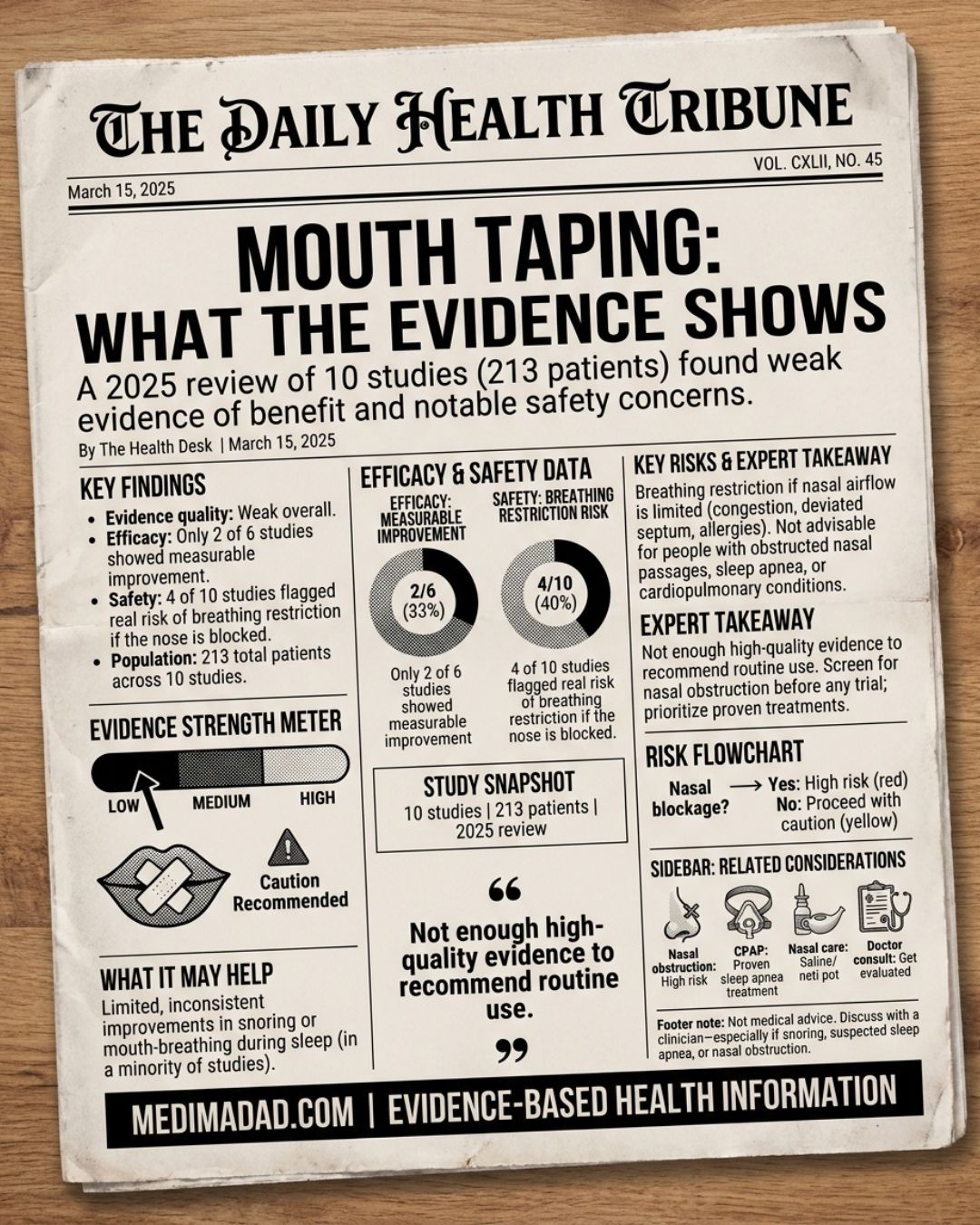
- A May 2025 systematic review pooled 10 studies on mouth taping (213 patients total). Every one of those studies was rated poor quality.
- Only 2 of 6 studies that measured breathing severity found a real improvement, and both were limited to mild sleep apnea in people without nasal blockage.
- 4 of the 10 studies flagged a real risk: taping your mouth shut with a blocked nose can restrict breathing dangerously, in rare cases to the point of suffocation risk.
- The reviewers’ own conclusion: current evidence does not support mouth taping as a real treatment for sleep-disordered breathing in the general population.
Where This Trend Actually Came From
Mouth tape didn’t start as a medical product. It spread the way most wellness trends do now: American podcasters and fitness influencers, Joe Rogan among them, started taping their mouths shut before bed and talking about it on camera. The claim was simple and appealing — nasal breathing is better than mouth breathing, so forcing it while you sleep should improve everything from snoring to energy to your jawline.
In India, the trend arrived the same way it usually does: through the same clips, the same influencers, and now a small but real market of mouth-tape products sold locally, some marketed as CDSCO approved. #MouthTaping has crossed 24 million views on TikTok. CNN’s own health podcast, Chasing Life with Dr. Sanjay Gupta, ran a full episode on it. This isn’t a weekend fad. It’s sustained enough that doctors have started pushing back in public.
What the Actual Research Says
In May 2025, researchers published a systematic review in PLOS ONE pooling every study on mouth taping they could find, going back to 1999. They ended up with 10 studies and 213 patients total — a genuinely small evidence base for a trend this big.
Six of those studies measured the Apnea-Hypopnea Index, the standard number doctors use to grade how severe someone’s sleep apnea is. Only two found a real improvement. Lee and colleagues saw the index drop from 8.3 to 4.7 events per hour; Huang and colleagues saw it drop from 12 to 7.8. Both results applied only to people with mild sleep apnea whose nasal passages were already clear — not to the general population trying this on TikTok’s recommendation.
The safety finding is the part that gets skipped in the reels. Four of the ten studies flagged a real risk: sealing your mouth shut when your nose is also blocked, whether from a cold, allergies, or a structural issue, restricts your only airway. The review’s authors were direct about it: this poses a genuine risk of restricted breathing, and in extreme cases, suffocation.
Every single one of the 10 studies was rated poor quality on the standard scale researchers use to judge study rigor. The reviewers’ own conclusion, stated plainly: the current evidence does not support mouth taping as a real clinical intervention for sleep-disordered breathing in the general population.
So Does Nasal Breathing Actually Matter?
This is the part worth separating out, because the underlying idea isn’t nonsense. Breathing through your nose during sleep genuinely is associated with better outcomes than mouth breathing in people who can already do it easily — it filters and humidifies air, and it’s linked to fewer awakenings. The problem isn’t the goal. It’s the method. Taping your mouth shut doesn’t fix whatever is making you a mouth breather in the first place — a blocked nose, enlarged tonsils, a deviated septum, or sleep apnea itself. It just removes your backup airway while that underlying problem is still there.
“It’s understandable why this trend caught on. Nasal breathing sounds like a simple, free fix, and taping your mouth feels like taking control of your own sleep. But ignoring the actual cause of mouth breathing carries real risk. If someone has a blocked nose from allergies or a deviated septum, or undiagnosed sleep apnea, taping their mouth doesn’t treat any of that. It just removes their backup airway. If you snore or wake up tired, the right first step is finding out why, not taping over the symptom. Ninety percent of the time that’s a proper sleep evaluation, not a strip of tape from an influencer’s bathroom shelf.”
— Dr. Ajit Kumar, MD (Medicine) | MA (Psychology) | Founder, Medimadad
What to Actually Do
- If you snore heavily, wake up gasping, or feel exhausted despite a full night’s sleep, that’s a reason to get evaluated for sleep apnea, not a reason to tape your mouth. Mouth taping can mask the symptom while the underlying condition goes untreated.
- If your nose feels blocked at night — from allergies, a cold, or a structural issue — do not tape your mouth. This is exactly the situation the review flagged as carrying real risk.
- If you’re simply curious about nasal breathing, treating the actual cause of any nasal congestion (allergy management, a saline rinse, seeing an ENT for a structural issue) addresses the real problem in a way tape never will.
- Children should never be given mouth tape without direct medical guidance — none of the reviewed studies evaluated pediatric use, and a child’s airway anatomy carries different risks.
Frequently Asked Questions
Is mouth taping safe?
Not established as safe for general use. A 2025 systematic review found 4 of 10 studies flagged a real risk of restricted breathing, particularly in people with any nasal blockage. It should never be tried by someone with a blocked nose, allergies, or diagnosed sleep apnea without a doctor’s involvement.
Does mouth taping cure snoring?
The evidence is thin and mixed. A few small studies found reduced snoring, but none of this research is strong enough to call it a proven treatment. Snoring often has an underlying cause — nasal blockage, weight, sleep position, or sleep apnea — that mouth tape doesn’t address.
Can mouth taping help with sleep apnea?
Only two studies found a real improvement in breathing severity, and both were limited specifically to mild sleep apnea in people with clear nasal passages. It is not a substitute for a proper sleep apnea diagnosis or treatment such as a CPAP machine, and could be actively dangerous for someone with more severe or undiagnosed apnea.
Why do so many influencers recommend it?
It’s a low-cost, visually simple habit that fits short-form video well, and the underlying idea (nasal breathing is healthier) is genuinely true, even though the method itself isn’t well supported by evidence. Popularity and evidence quality aren’t the same thing.
References
- Systematic review on mouth taping for mouth breathing, sleep-disordered breathing, and obstructive sleep apnea. PLOS ONE. May 2025.
Related on Medimadad→ Why You Wake Up Tired After 8 Hours of Sleep | Wrong Sleep Duration Is Aging Your Brain, Heart and Lungs Faster | Do Sleep Trackers Actually Work?
Get free weekly health insights from Dr. Ajit Kumar
Join thousands of readers. No spam. Unsubscribe anytime.
