
Medically Written & Reviewed by Dr. Ajit Kumar, MD (Medicine) | MA (Psychology), Founder of Medimadad. Last reviewed: September 2026. This article is for informational purposes only and does not constitute medical advice. Read our Editorial Policy.
Key Takeaways
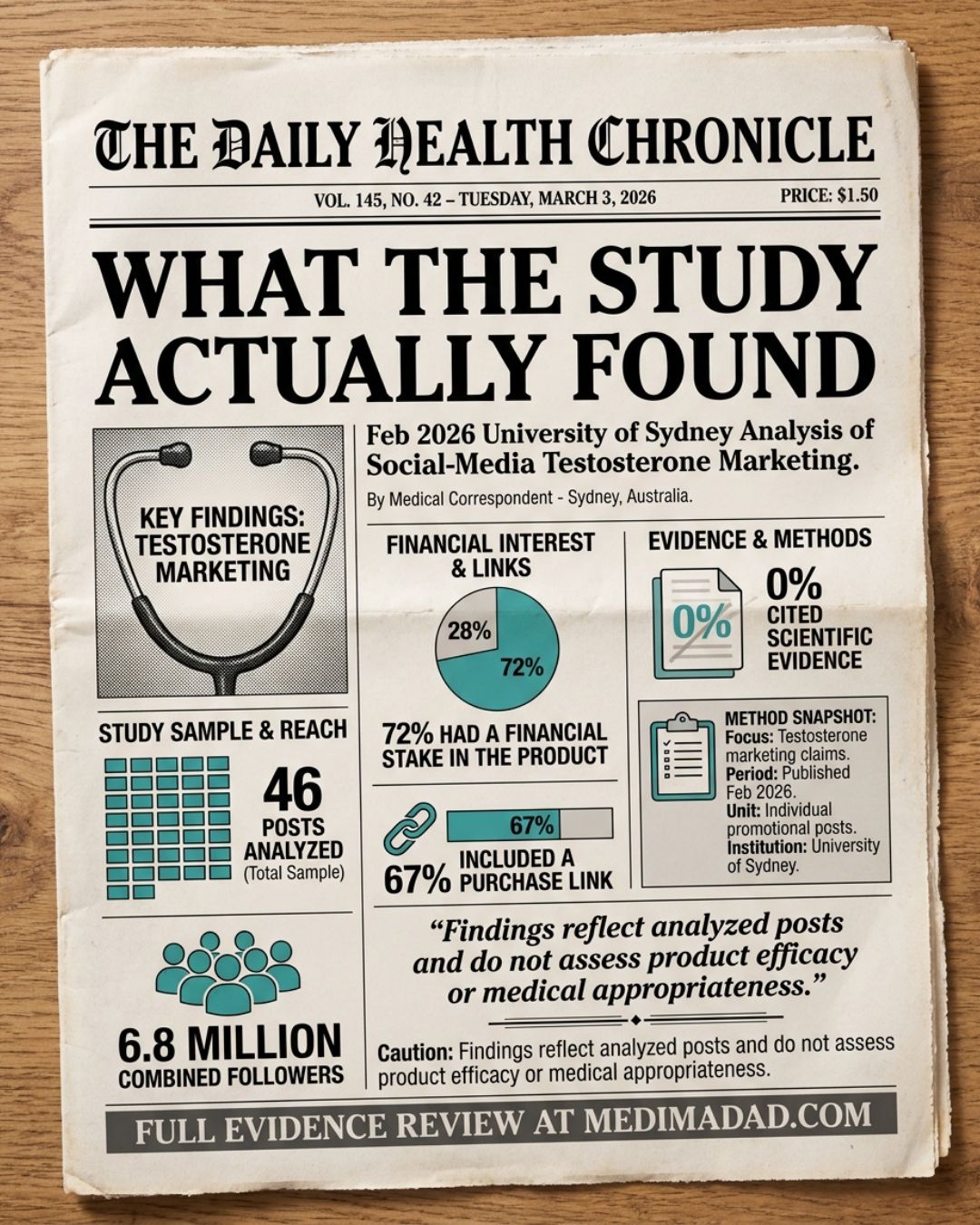
- A February 2026 study from the University of Sydney analysed 46 high-reach Instagram and TikTok posts about testosterone. 72% of the accounts had a financial interest in what they were promoting: a supplement, a test kit, or a clinic consultation. None cited scientific evidence.
- Ordinary experiences like tiredness, stress, a lower sex drive, and getting older are being reframed online as symptoms of a hormone “deficiency” that supposedly needs treatment.
- Real, clinically low testosterone exists and is worth checking for. The problem isn’t the condition. It’s how it’s being marketed to healthy men who don’t have it.
- India’s testosterone-booster and clinic market is largely unregulated, sold online with no prescription required, which makes this specific type of marketing pressure even easier to act on here than in countries with tighter oversight.
The Video That Started This
If you spend any time on Instagram or TikTok as a man under 40, you’ve probably seen it: a confident guy in a gym mirror, or a clinic waiting room, listing off symptoms that sound uncomfortably familiar. Tired by 3pm. Motivation gone. Libido not what it used to be. Then the reveal: “I got my testosterone tested, and it explained everything,” followed by a link to a test kit, a supplement, or a telehealth clinic.
One post analysed in the study came from a creator with 102,000 TikTok followers, who used morning erectile function as a marker of low testosterone. It’s a striking claim. It’s also not how testosterone actually gets diagnosed.
What the Study Actually Found
Researchers at the University of Sydney’s Faculty of Medicine and Health, led by Emma Grundtvig Gram, a visiting PhD student from the University of Copenhagen, with senior author Dr Brooke Nickel and co-author Dr Ray Moynihan, analysed 46 high-reach Instagram and TikTok posts about testosterone testing and treatment. The accounts behind them had a combined 6.8 million followers and had generated more than 650,000 likes on this content alone.
Published in Social Science & Medicine, here’s what they found:
- 85% of the posts came from individual creators, not health organisations or clinicians.
- 67% included a direct purchase link: a test, a supplement, a consultation.
- 72% had a financial interest in the product or service being discussed.
- 0% cited scientific evidence for the claims being made.
The researchers connected this pattern to the online “manosphere,” a loose cluster of communities that frame men’s health and identity around dominance, physical strength, and sexual performance. As Dr Nickel put it: “What we’re seeing isn’t health education, it’s marketing and fearmongering dressed up as medical advice.”
So Is Low Testosterone Real? Yes. But It’s Rarer and More Specific Than the Videos Suggest
This is the part that gets lost in the outrage cycle around content like this: clinically low testosterone, medically called hypogonadism, is a real condition. It’s just far more specific, and far less common, than a fatigue-and-low-libido checklist implies.
The actual diagnostic bar, per international endocrine society guidelines, is stricter than most people assume. A man needs both consistent symptoms and a confirmed low serum total testosterone level, drawn in the morning (testosterone is naturally highest then and falls through the day), on two separate occasions. Not one test. Not an afternoon draw. And not a home finger-prick kit sold through a TikTok link. A single low reading, especially one taken at the wrong time of day, isn’t a diagnosis. It’s a data point that needs to be repeated properly before it means anything.
Fatigue, stress, and a lower sex drive have dozens of more common causes: poor sleep, a heavy workload, anxiety, alcohol, weight gain, undiagnosed diabetes, thyroid issues. A good clinical workup checks these before testosterone is even on the list. Treating them as automatically hormonal, and reaching for a supplement or TRT first, skips that entire process.
The India-Specific Risk
Everything the Sydney study documented is a global phenomenon, but it lands differently in India. In the US and UK, prescription testosterone therapy generally requires a doctor’s involvement, even through telehealth. In India, testosterone-boosting supplements are sold openly online with no prescription, no age verification, and largely no quality regulation. Reports on the supplement market describe a mix of legitimate and counterfeit products sitting side by side on the same marketplaces, with documented cases of liver toxicity, kidney strain, and cardiovascular events tied to high-dose or adulterated formulations.
Aggressive social-media marketing plus an unregulated purchase path is a combination that shortens the gap between “I saw a worrying video” and “I bought something risky,” more so here than in most of the markets these studies are conducted in.
“This is a familiar pattern: a patient convinced he has ‘low T’ because of something he watched, when his actual testosterone is often completely normal. What’s low is his sleep, or he’s under real financial or work stress, or nobody has checked his thyroid. The honest, unglamorous truth is that most fatigue in men under 40 has nothing to do with testosterone. Low testosterone does happen, and it’s worth taking seriously when it’s real. But the right approach is: get it tested properly, twice, in the morning, and interpreted in context by a doctor — not sold to based on a reel.”
— Dr. Ajit Kumar, MD (Medicine) | MA (Psychology) | Founder, Medimadad
What to Actually Do If You’re Worried
- Don’t start with a supplement or a clinic consult you found through an ad. Start with your regular doctor, or a general physician if you don’t have one.
- Ask for the right test, done right: a morning total testosterone level (before 10am), repeated on a second day if the first result is low. A single afternoon reading is not enough to act on.
- Rule out the common causes first: sleep quality, thyroid function, blood sugar, and general stress load are all more common explanations for fatigue and low libido than a hormone deficiency, and your doctor will likely check some of these alongside testosterone.
- If your levels genuinely come back low, that’s a real conversation to have with a doctor about causes and options, including the evidence-based natural options (zinc, ashwagandha, fenugreek) covered in our separate natural testosterone boosters guide, and when TRT is and isn’t appropriate.
- Be skeptical of any post that both diagnoses you and sells you the solution in the same breath. That’s the exact pattern the Sydney study found in 72% of the content it reviewed.
Frequently Asked Questions
Can I tell if I have low testosterone just from symptoms like tiredness or low libido?
Not reliably. Poor sleep, stress, thyroid problems, depression, alcohol use, and being overweight are all more common causes of tiredness and low libido than low testosterone in men under 40. Symptoms alone, without a confirmed low blood test on two separate mornings, aren’t a diagnosis.
Is testosterone replacement therapy (TRT) dangerous?
When it’s genuinely needed and properly monitored by a doctor, TRT can be safe and effective for real, diagnosed hypogonadism. The risk highlighted by the Sydney study is different: healthy men without a real deficiency starting TRT or high-dose supplements based on influencer marketing, which carries real risks including cardiovascular problems, fertility impairment, and kidney strain, for no clinical benefit.
Why would an influencer lie about having low testosterone?
The Sydney study found 72% of the accounts studied had a direct financial interest, selling a supplement, a test kit, or a paid clinic consultation. That doesn’t mean every creator is being deliberately dishonest, but it does mean the incentive to diagnose viewers with a treatable problem is built into the business model for a large share of this content.
Where can I get a legitimate testosterone test in India?
A morning total testosterone blood test is available through any standard diagnostic lab with a doctor’s requisition, and is a routine, inexpensive test. The safer path is asking your doctor to order it as part of a broader checkup, rather than ordering a home kit through a social media link.
References
- Grundtvig Gram E, Nickel B, Moynihan R, et al. Influencer marketing of testosterone testing and treatment on social media. Social Science & Medicine. 2026.
- University of Sydney. “‘Masculinity crisis’: Influencers on social media promote low testosterone to young men, study finds.” February 2026.
- Bhasin S, et al. Testosterone Therapy in Men With Hypogonadism: An Endocrine Society Clinical Practice Guideline.
Related on Medimadad→ Natural Testosterone Boosters: Zinc, Ashwagandha and Fenugreek | Cold Therapy and Testosterone: What the Science Actually Shows | The Hidden Link Between Blood Sugar and Male Sexual Health
Get free weekly health insights from Dr. Ajit Kumar
Join thousands of readers. No spam. Unsubscribe anytime.
