

By Dr. Ajit Kumar, MD (Medicine) — Founder, Medimadad. About the Author | Editorial Policy
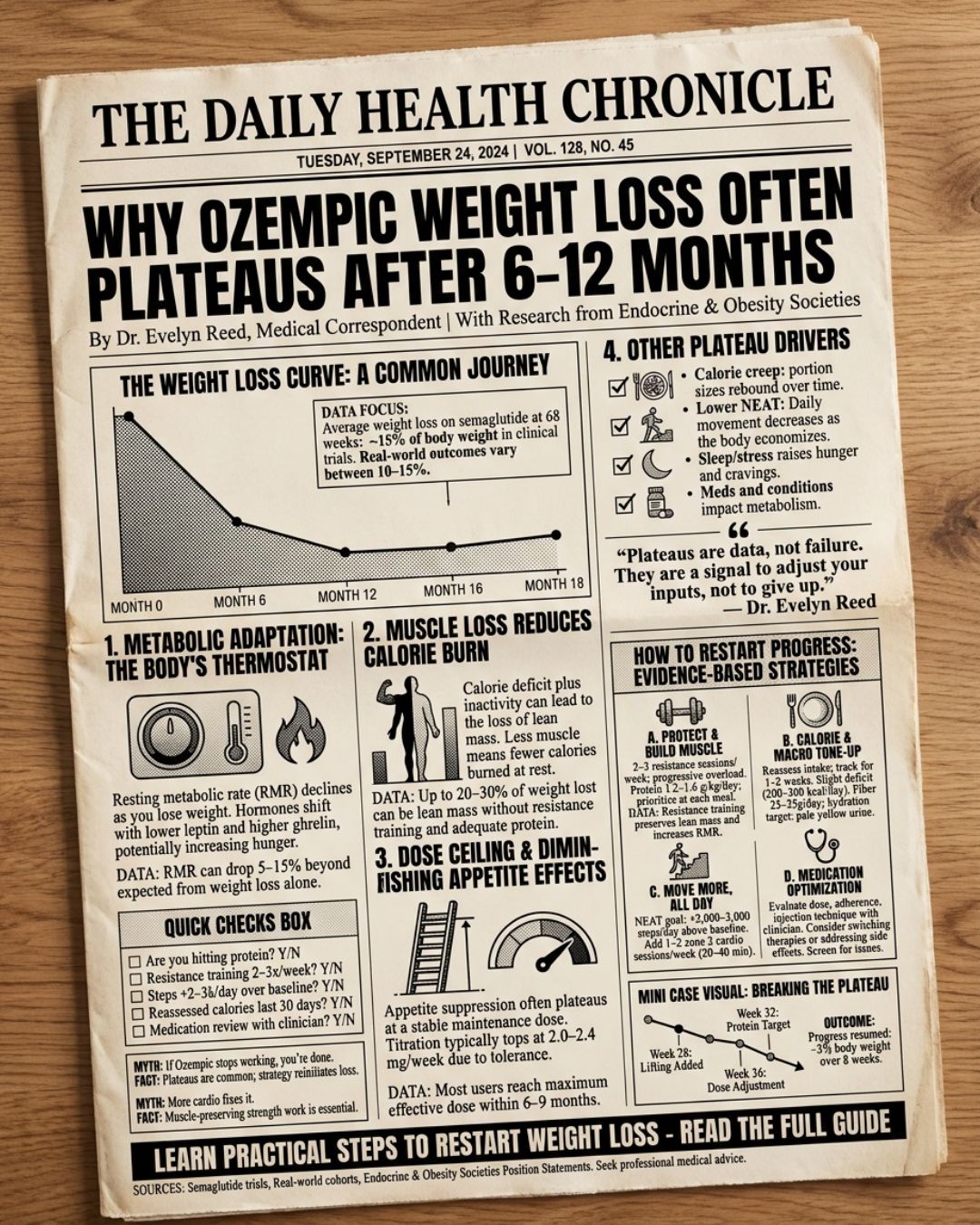
Somewhere around month four or five, I start getting the same message from patients on semaglutide: the scale has stopped moving, and they want to know if something’s gone wrong. It hasn’t. What they’re describing has a name now, and — as of a study published in Nature Metabolism this May — an actual mechanism behind it, not just a shrug and “plateaus happen.”
What’s actually happening in the brain
Semaglutide works by binding to GLP-1 receptors in the area postrema, a small appetite-control region at the base of the brain. That binding raises a signalling molecule called cAMP, which is what produces the appetite suppression patients feel in the first months. The NIH team, led by Claire Gao and Michael Krashes, used fluorescence imaging to watch this happen in real time in living brain tissue — the first direct observation of this receptor behavior, rather than an inference from blood tests or patient-reported outcomes.
What they found explains the plateau: not every neuron responds the same way. Some keep their cAMP response elevated over time. Others spike briefly and then shut themselves down — by internalizing or breaking down their own GLP-1 receptors. As Krashes put it, “It was not an all or nothing phenomenon. We observed that cAMP responses across cells varied on a continuum.” The plateau isn’t the drug failing. It’s a growing share of neurons quietly opting out.
The part I actually find useful for patients
The clinically useful reframe here isn’t the neuroscience itself — it’s what it implies. A plateau is not evidence of anything you did wrong. It’s not a discipline failure, and it’s not a sign the drug has “stopped working” in the way patients usually mean when they ask me that question. It’s a specific, measurable biological process running its course in a specific brain region. I’ve found that this distinction alone changes how people respond to a plateau — from panic or self-blame to something they can plan around.
Is there a way through it?
Possibly. The same research team tested roflumilast, a drug that blocks the enzyme PDE4 — the enzyme responsible for breaking down cAMP. Blocking it kept more neurons in their responsive state, effectively counteracting the desensitization. This is early: the experiments so far only track effects over hours, not the days-to-weeks timeline that matters clinically. But it points toward a plausible next generation of combination therapy — a GLP-1 agonist paired with something that keeps the brain’s response from fading.
What I’d actually discuss with a patient who’s plateaued
None of the following is a substitute for a conversation with your own prescriber, but these are the real levers:
- A dose adjustment, which can re-engage receptors that have gone quiet
- Cycling off and back onto the medication under supervision — early evidence suggests this may partially restore sensitivity, though this isn’t yet standard practice
- Resistance training and adequate protein intake, which matter more during a plateau than earlier in treatment, since preserving muscle mass becomes the priority once rapid loss slows
- Whether a dual-agonist option like tirzepatide, which engages both GLP-1 and GIP receptors, might be worth discussing as an alternative pathway
A note on supporting metabolic health during a plateau
Berberine has reasonable clinical trial support for improving insulin sensitivity, which is relevant to the metabolic side of a plateau even though it doesn’t address the receptor-desensitization mechanism directly.
This is an affiliate link – we may earn a commission at no extra cost to you. See our Affiliate Disclosure.
The bottom line
A stalled scale after months of steady progress on Ozempic or Wegovy is not a failure — it’s receptor desensitization, a defined and measurable process, not a mystery and not a verdict on your effort. The research pipeline is now aimed squarely at reversing it. In the meantime, the honest answer is: talk to your doctor about the levers above, and don’t let a plateau talk you out of a treatment that was working.
Medically reviewed by Dr. Ajit Kumar, MD (Medicine) | Healthcare Consultant | Editorial Board Member, Medimadad Health Editorial Team. This article is for informational purposes only and does not constitute medical advice. Always consult a qualified healthcare professional before starting or changing any medication.
Further Reading
Related on Medimadad
Get free weekly health insights from Dr. Ajit Kumar
Join thousands of readers. No spam. Unsubscribe anytime.
