

By Dr. Ajit Kumar, MD (Medicine) — Founder, Medimadad. About the Author | Editorial Policy
Update, July 2026: the World Health Organization officially declared this outbreak over on 2 July 2026, after the last close contact completed quarantine with no further cases. The account below reflects the final, confirmed picture of what happened.
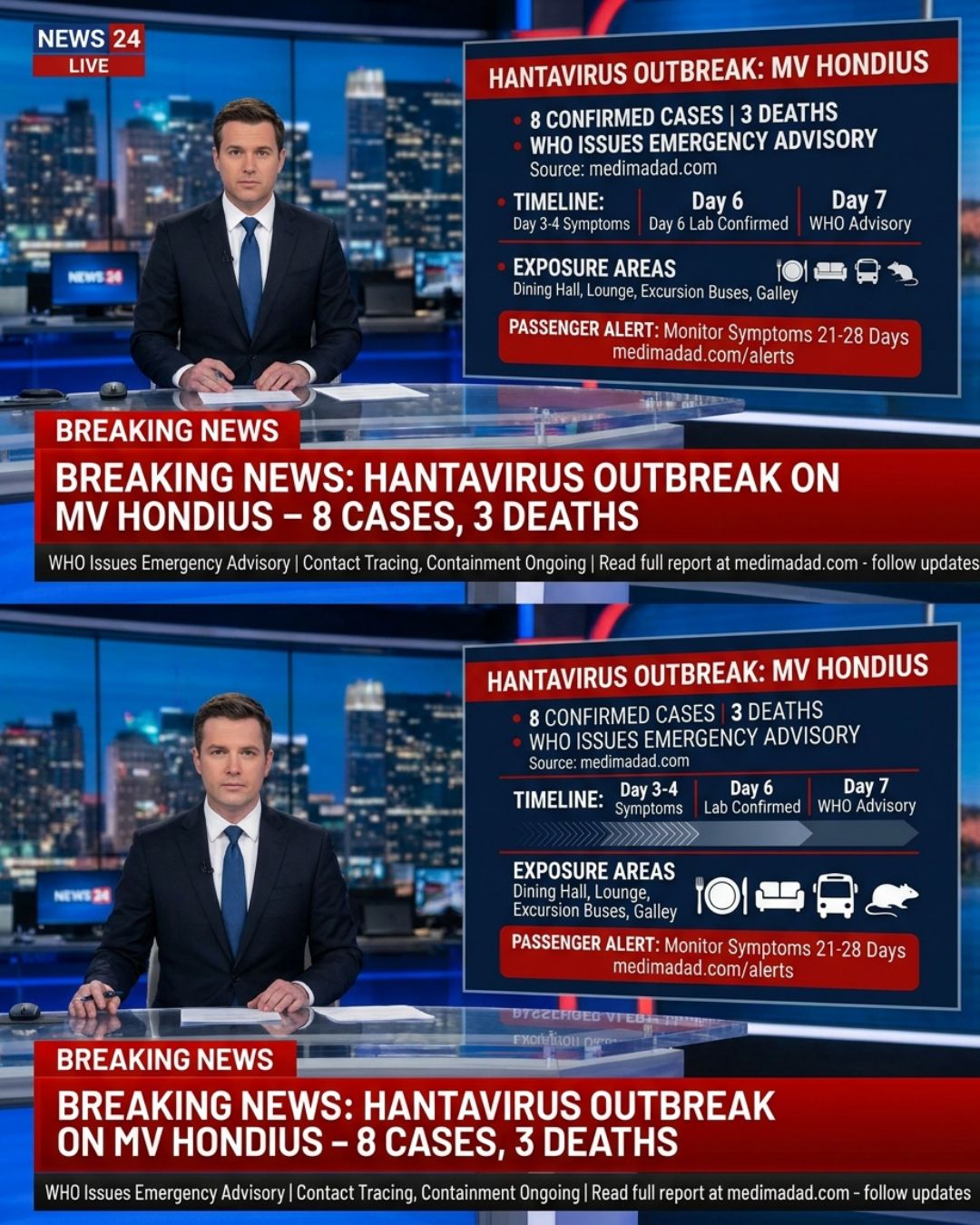
In April 2026, a luxury cruise ship became the centre of a global health alert after the World Health Organization confirmed a cluster of hantavirus infections among passengers of the Dutch-flagged expedition vessel MV Hondius. By the time the outbreak concluded, 13 people had been infected and three had died. The culprit: the Andes virus – the only known strain of hantavirus that can spread directly from person to person.
Contact tracing eventually stretched across 33 countries and territories, covering passengers, crew, airline contacts, healthcare workers, and airport staff. Here is what happened, what hantavirus does to the body, and what the outbreak’s resolution means going forward.
What Happened on the MV Hondius?
The MV Hondius is a luxury expedition ship known for remote Antarctic and South Atlantic voyages. WHO investigators concluded the earliest cases most likely acquired the infection on land, before boarding, with limited additional transmission occurring between people aboard the ship afterward. The first known case had spent time in South America before boarding on April 1, 2026, with symptoms appearing days later.
By the time WHO closed its investigation, the outbreak had reached 13 total cases – 12 laboratory-confirmed and one probable – with 3 deaths, a case fatality rate of 23 percent. Former passengers were hospitalised or quarantined across a wide span of countries, including Australia, Canada, France, Germany, the Netherlands, Saint Helena, Singapore, South Africa, Spain, Switzerland, Turkey, and the United States, with contact tracing ultimately covering 33 countries and territories in total.
What Is Hantavirus – and Why Is the Andes Strain Different?
Hantavirus is a family of viruses carried primarily by rodents. In most cases, humans catch it by coming into contact with infected rodent droppings, urine, or saliva. What makes the Andes virus uniquely dangerous is that it is the only hantavirus strain known to spread from one infected person to another.
This person-to-person transmission happens through close, prolonged contact with someone who is already symptomatic – through respiratory secretions, direct physical contact, or extended time in shared enclosed spaces. On a cruise ship with narrow corridors, shared dining rooms, and small cabins, that single biological difference changed the nature of the outbreak entirely.
Symptoms to Watch For
Hantavirus Warning Signs – When to Seek Emergency Care
Fever, fatigue, and muscle aches. Appearing 4 to 42 days after exposure, these early symptoms resemble a bad flu. Deep pain in the thighs, hips, back, and shoulders is a hallmark sign.
Headache, dizziness, and gut symptoms. Nausea, vomiting, diarrhoea, and abdominal pain are common in the early phase, which can last four to ten days.
Sudden worsening breathlessness – this is the emergency. The second phase involves rapid lung fluid buildup and respiratory failure. Without immediate ICU care, it can be fatal within hours.
If you have any potential exposure history and develop these symptoms, go to emergency care immediately and tell the doctor about your travel or contact history.
The disease follows two phases. The early phase mimics a severe flu and can seem to improve temporarily – a deceptive lull that has led to delayed care. The second phase is the critical window: patients develop acute respiratory distress as their lungs fill with fluid. Without mechanical ventilation and intensive support, this phase can kill within hours of onset.
How Does Hantavirus Spread?
The primary route remains rodent contact – touching infected droppings, urine, nesting materials, or the animals themselves, then touching the face. Inhaling dried, aerosolised rodent waste in enclosed or poorly ventilated spaces is another known route.
For Andes virus specifically, person-to-person transmission is documented – it requires close, sustained contact with a symptomatic person. This includes direct physical contact, exposure to respiratory secretions or saliva, or prolonged time in the same enclosed space. The WHO has confirmed this type of transmission occurred aboard the MV Hondius.
Is There Still a Risk?
No – not from this specific event. With the outbreak declared over on 2 July 2026 and every close contact cleared from quarantine with no further cases, the risk connected to the MV Hondius is gone. Throughout the outbreak, the CDC and WHO both confirmed that risk to the general public stayed low, no travel restrictions were issued, and the event remained linked to this one vessel and its specific exposure events.
The broader, ongoing risk – separate from this resolved outbreak – is what it always was: exposure to rodent droppings, urine, or nesting material, particularly for people who have recently travelled to rural or remote areas of South America (Patagonia, Chile, and Argentina especially), or who work in environments with rodent exposure such as farms, forests, grain stores, or older rural buildings.
How to Protect Yourself
There is no approved antiviral drug or vaccine for hantavirus. Treatment is entirely supportive care – keeping lungs working while the immune system fights the infection. Prevention and early recognition are your only real defences.
Key preventive steps include sealing food in rodent-proof containers, ventilating enclosed spaces before entering, wearing gloves when clearing areas that may have rodent activity, and washing hands thoroughly after outdoor activity in rural or forested areas.
Maintaining a strong immune system is your body’s first line of defence against any respiratory pathogen. Chronic stress and nutritional deficiencies suppress immune function at the cellular level – making recovery from respiratory illness significantly harder.
How Health Authorities Responded
The WHO coordinated a multi-country response, monitoring every high-risk contact from the MV Hondius for 42 days – the maximum known incubation period for Andes virus – before formally declaring the outbreak over on 2 July 2026. Cruise ship operators faced increased scrutiny over rodent control protocols and early illness detection aboard vessels, scrutiny likely to shape industry practice going forward.
The CDC issued a Health Alert Notice for US clinicians during the outbreak, urging them to consider Andes virus in patients presenting with hantavirus pulmonary syndrome symptoms and a history of South American travel or contact with MV Hondius passengers. The European Centre for Disease Prevention and Control published a risk assessment concluding that the overall public health risk to Europe stayed low throughout, while recommending heightened clinical awareness – guidance that remains sound practice even with the outbreak now closed.
The Bottom Line
This outbreak was a rare and alarming event – not because it signalled a new pandemic, but because it showed how quickly an obscure rodent-borne virus can become a multi-country public health event in a globalised world, even while ultimately staying contained. The Andes virus remains the most dangerous strain in the hantavirus family, and its appearance on a luxury cruise ship with international passengers was a reminder that infectious disease respects neither borders nor wealth.
With the outbreak formally over, the risk to you personally from this specific event is now zero. But the underlying lesson holds for any future exposure: knowing the symptoms, the exposure history that raises your risk, and when to seek emergency care could be lifesaving.
Dr. Ajit Kumar’s take
“What stood out to me about this outbreak was not the virus itself – Andes virus has been known for decades – but how fast a genuinely low-probability event can escalate once person-to-person spread enters a closed environment like a ship. The practical lesson for travellers has nothing to do with cruises specifically: if you have recently spent time in rural South America and develop a flu-like illness with unusually severe muscle pain, tell your doctor about the travel history explicitly. Hantavirus pulmonary syndrome is treatable with early, aggressive supportive care, but only if it is suspected early enough to act on. That one sentence of travel history is often the difference between a fast diagnosis and a dangerous delay.”
– Dr. Ajit Kumar, MD Medicine | Healthcare Consultant and Health Educator, Founder of Medimadad
Get free weekly health insights from Dr. Ajit Kumar
Join thousands of readers. No spam. Unsubscribe anytime.
