

By Dr. Ajit Kumar, MD (Medicine) — Lifetime Member, Indian Medical Association. About the Author | Editorial Policy
Dementia affects over 55 million people worldwide — and that number is projected to nearly triple by 2050. In India alone, more than 8 million people are currently living with some form of dementia, with Alzheimer’s disease being the most common. Yet a landmark statement from the American Heart Association, backed by decades of research, confirms something that should change how every person over 40 thinks about their daily life: dementia is significantly preventable.
The lifestyle factors that protect your brain are not exotic or expensive. They are within reach for most people — and starting today matters more than starting perfectly later.
What the Research Actually Says
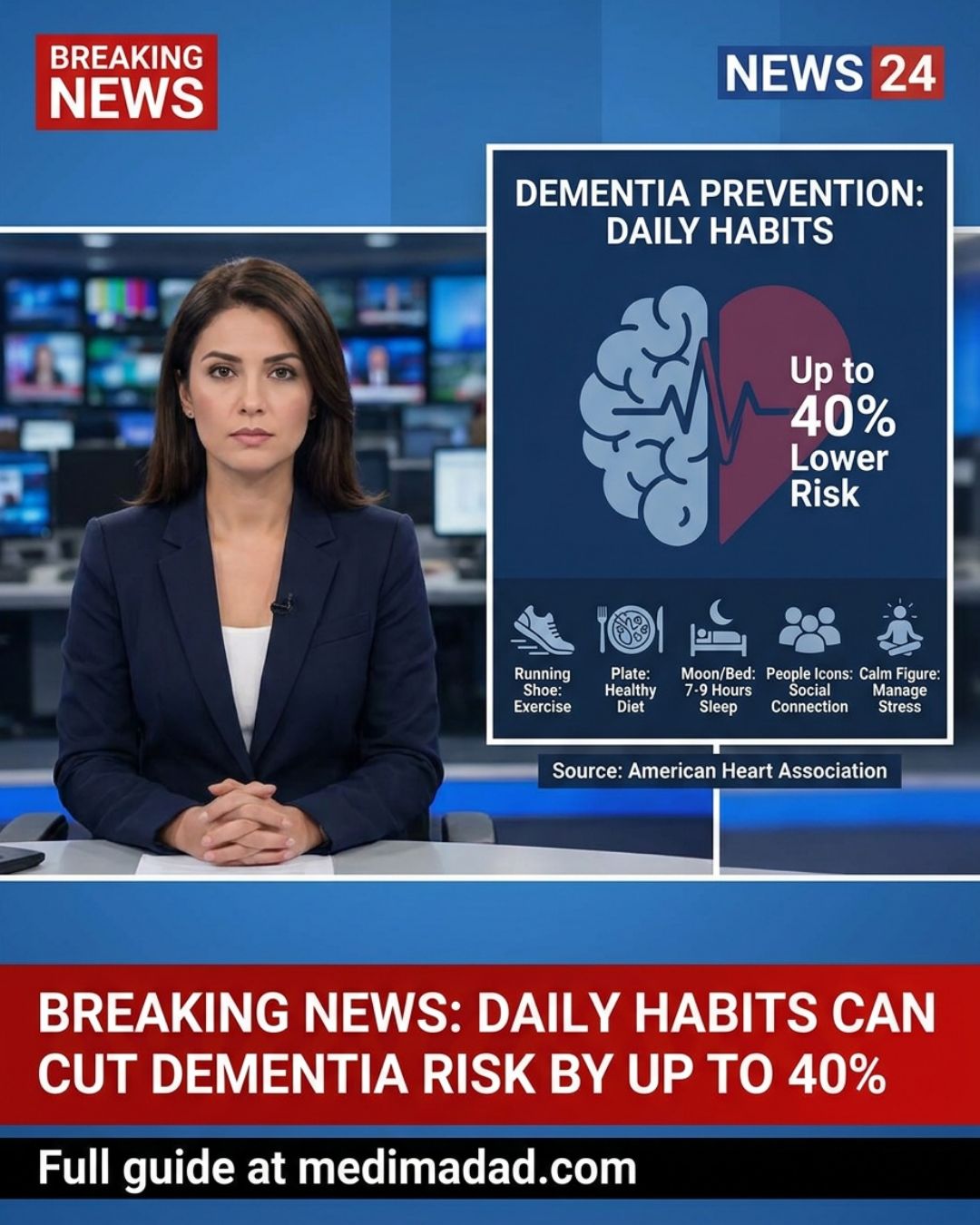
The American Heart Association’s scientific advisory identifies a set of lifestyle factors — collectively called “Life’s Essential 8” — that measurably reduce the risk of both cardiovascular disease and cognitive decline. Studies tracking hundreds of thousands of people over decades consistently show that people who follow these habits have 40 to 60 percent lower risk of developing dementia compared to those who do not.
Separately, the Lancet Commission on Dementia Prevention, Intervention and Care — which draws on the pooled findings of hundreds of studies — has identified 14 modifiable risk factors that together account for roughly 45 percent of all dementia cases worldwide. This means nearly half of all dementia is theoretically preventable through lifestyle and environmental changes alone, even without new drugs or medical breakthroughs.
The 8 Lifestyle Factors That Protect Your Brain
Life’s Essential 8 — Brain Protection Checklist
1. Physical activity. At least 150 minutes of moderate exercise per week. Exercise increases blood flow to the brain and stimulates new neuron growth in the hippocampus — the brain’s memory centre.
2. Healthy diet. A Mediterranean or MIND diet — rich in fish, leafy greens, berries, olive oil, whole grains, and nuts — reduces dementia risk by up to 35 percent in long-term studies.
3. Quality sleep. Seven to nine hours per night. During sleep, the brain activates its glymphatic system — a waste-clearance process that flushes out beta-amyloid and tau proteins linked to Alzheimer’s disease.
4. Not smoking. Smoking doubles the risk of dementia. Quitting at any age reduces risk, with significant benefits seen within two to four years of stopping.
5. Healthy weight. Obesity in midlife is associated with significantly higher dementia risk, likely through inflammation and vascular damage pathways.
6. Controlled blood pressure. Hypertension is the single largest modifiable risk factor for dementia globally. Keeping blood pressure below 130/80 mmHg protects the brain’s blood vessels from damage.
7. Healthy blood sugar. Type 2 diabetes increases dementia risk by 60 percent. Even pre-diabetes silently damages blood vessels supplying the brain over years.
8. Healthy cholesterol. High LDL cholesterol in midlife is independently linked to higher Alzheimer’s risk through plaque formation and vascular inflammation in the brain.
Three More Factors the Research Highlights
Social Connection
Chronic loneliness and social isolation are now classified as major dementia risk factors — the cognitive equivalent of smoking 15 cigarettes a day according to one large meta-analysis. Maintaining active social relationships, especially after retirement, appears to preserve cognitive function by keeping neural networks engaged and reducing stress hormones. People who regularly socialise, volunteer, or participate in community activities consistently show slower cognitive decline than those who are socially isolated, even when other risk factors are controlled for.
Stress Management
Chronic stress floods the brain with cortisol, which physically damages the hippocampus over time. People with poorly controlled chronic stress have measurably smaller hippocampal volumes and faster cognitive decline. Daily practices that reduce cortisol — exercise, meditation, social connection, adequate sleep — all converge on the same protective mechanisms.
Mental Stimulation
Reading, learning new skills, playing strategy games, and engaging in mentally demanding work build cognitive reserve — a buffer that allows the brain to function normally even when physical changes begin. People with high cognitive reserve show dementia symptoms an average of five years later than those with low reserve, even when brain pathology is similar. Higher education, bilingualism, and lifelong learning have all been independently associated with delayed dementia onset in large cohort studies.
Hearing Loss: The Overlooked Risk Factor
One of the most underappreciated dementia risk factors is untreated hearing loss. The Lancet Commission identifies it as the single largest modifiable dementia risk factor in midlife — accounting for approximately 8 percent of dementia cases globally. The mechanism is twofold: the cognitive effort required to decode degraded auditory signals depletes mental resources, and social withdrawal caused by hearing difficulty reduces the brain stimulation that builds cognitive reserve.
Studies show that people with moderate untreated hearing loss have nearly triple the risk of dementia compared to those with normal hearing. The good news is that a major 2023 clinical trial found that fitting hearing aids in older adults with hearing loss reduced the rate of cognitive decline by 48 percent over three years. If you or a family member have noticeable hearing difficulty, addressing it early is one of the highest-impact steps available for brain protection.
The FINGER Trial: Proof That Prevention Works
The FINGER trial (Finnish Geriatric Intervention Study to Prevent Cognitive Impairment and Disability) is the most rigorous proof of concept for lifestyle-based dementia prevention to date. Published in The Lancet, the trial enrolled over 1,200 at-risk adults aged 60 to 77 and randomised them to either a comprehensive lifestyle intervention (exercise, nutrition, cognitive training, and vascular risk management) or general health advice.
After two years, the intervention group showed 25 percent better performance on cognitive tests overall, with even larger improvements in executive function (83 percent better) and processing speed (150 percent better) compared to the control group. The participants did not receive any drugs — only structured lifestyle guidance. The FINGER model has since been replicated in multiple countries with consistent results, confirming that a multidomain lifestyle intervention started before significant cognitive decline begins is one of the most powerful tools available for preserving brain function.
Early Warning Signs: When to See a Doctor
Many people confuse normal age-related memory changes with early dementia. Normal aging involves occasional lapses — forgetting where you put your keys, taking longer to recall a name. Early dementia typically involves more persistent and functional changes: getting lost in familiar environments, forgetting recent conversations entirely, struggling with tasks that were previously routine, or showing personality changes that are uncharacteristic.
If you or a family member notice consistent changes in memory, language, orientation, or behaviour over several months, a consultation with a neurologist is warranted. Blood tests can rule out reversible causes of cognitive decline — thyroid dysfunction, B12 deficiency, folate deficiency, and anaemia are all treatable causes of memory problems that mimic early dementia. Brain imaging can identify structural changes. Earlier diagnosis means earlier intervention — and the earlier lifestyle strategies are implemented, the more brain tissue they protect.
Why Indians Face a Particularly High Risk
India faces a compounding set of risk factors for dementia. Hypertension affects over 200 million Indians. Type 2 diabetes has reached epidemic proportions. Physical activity levels are declining rapidly in urban populations. Social isolation is increasing as joint family systems break down. Awareness of dementia as a preventable condition remains extremely low. Air pollution — a newly identified dementia risk factor — is a significant environmental burden across Indian cities.
Additionally, the stigma around cognitive decline in Indian families often delays diagnosis by years, meaning interventions begin too late to have maximum impact. The good news is that every single one of these risk factors is modifiable. The tools for dramatically reducing India’s future dementia burden already exist — they just need to be applied consistently.
Brain-Supportive Supplements: What the Evidence Supports
While lifestyle changes form the foundation of dementia prevention, certain evidence-backed supplements can provide additional support. Omega-3 fatty acids (EPA and DHA) are the most researched brain health supplements, with strong evidence for reducing neuroinflammation and slowing cognitive decline. For more on omega-3 deficiency in Indian adults, see our guide on omega-3 deficiency and its consequences. Creatine monohydrate has also shown emerging benefits for brain energy metabolism — read our full guide on creatine for brain health.
Get your personalized numbers: Omega-3 Intake Calculator and Creatine Dosage Calculator.
Recommended: For convenient daily brain support, check out this highly rated brain health supplement on Amazon India — view it here. A simple addition to your daily routine that supports memory, focus, and long-term cognitive health.
This is an affiliate link – we may earn a commission at no extra cost to you. See our Affiliate Disclosure.
Frequently Asked Questions
At what age should you start preventing dementia?
The research suggests that lifestyle habits formed in your 40s and 50s have the strongest impact on dementia risk in your 70s and 80s. Midlife is when vascular risk factors begin damaging brain blood vessels. Starting in your 40s is ideal, but the FINGER trial demonstrated measurable benefits even in adults aged 60 to 77, so it is never too late to start.
Is Alzheimer’s disease hereditary?
Having a parent or sibling with Alzheimer’s increases your risk, but most cases are not caused by a single inherited gene. The most significant genetic risk factor is the APOE-e4 variant, which approximately 25 percent of people carry in one copy. Carrying APOE-e4 raises risk but does not make Alzheimer’s inevitable — lifestyle factors remain highly influential even in genetically predisposed individuals.
Does high blood pressure cause dementia?
Hypertension is the single largest modifiable risk factor for dementia globally. Uncontrolled high blood pressure damages the small blood vessels supplying the brain, causing silent ministrokes and white matter lesions that accumulate over years. Treating hypertension aggressively — targeting below 130/80 mmHg — is one of the most evidence-backed interventions for dementia prevention available to clinicians today.
Can exercise reverse early cognitive decline?
Exercise cannot reverse established Alzheimer’s pathology, but it can meaningfully slow decline and improve function in people with mild cognitive impairment. Aerobic exercise increases the production of BDNF (brain-derived neurotrophic factor), a protein that supports new neuron growth in the hippocampus. Studies show that individuals with mild cognitive impairment who exercise regularly have larger hippocampal volumes and better memory performance than sedentary controls after 12 months.
Does untreated hearing loss increase dementia risk?
Yes. Untreated hearing loss is identified by the Lancet Commission as the single largest modifiable dementia risk factor in midlife, accounting for around 8 percent of global dementia cases. A major 2023 clinical trial found that hearing aids reduced cognitive decline rates by 48 percent over three years in older adults with hearing loss. If hearing difficulty is present, addressing it early is one of the highest-impact actions available for brain protection.
Dr. Ajit Kumar’s clinical perspective
“The hearing loss connection is the one that genuinely surprises most people — nobody thinks of a hearing test as a dementia-prevention tool. Screening for hearing difficulty deserves to be as routine as checking blood pressure in patients over 60, specifically because it’s so underappreciated and so fixable. More broadly, the key takeaway from the FINGER trial for people in their 40s and 50s is that this isn’t vague wellness advice — a structured, multi-domain lifestyle intervention produced measurable, significant cognitive improvement in a real randomized trial, with no drug involved. That should change how seriously someone takes the boring daily habits — blood pressure control, sleep, exercise, staying socially engaged.”
— Dr. Ajit Kumar, MD Medicine | Healthcare Consultant and Health Educator, Founder of Medimadad
The Bottom Line
Dementia is not an inevitable consequence of aging. The research is unambiguous — the lifestyle choices you make in your 40s, 50s, and 60s directly determine your brain health in your 70s and 80s. Exercise regularly, eat a brain-protective diet, sleep well, manage your blood pressure and blood sugar, stay socially connected, keep learning, protect your hearing, and manage stress.
These are not complicated or expensive interventions. They are the daily habits that science has now confirmed, with high certainty, to be the most powerful tools for keeping your mind sharp for life. The FINGER trial proved it works. The Lancet Commission mapped the pathway. Now the question is whether you will apply it.
For more evidence-based health guides, visit medimadad.com.
Further Reading
- → Wrong Sleep Duration Is Aging Your Brain, Heart and Lungs Faster – Scientists Find the Exact Safe Zone
- → The Real Reason You Wake Up Tired Even After 8 Hours of Sleep
- → Do Sleep Trackers Actually Work? An Honest Review of the Science
- → Migraines With Aura Are Linked to 4x Higher Stroke Risk – What Neurologists Want Every Sufferer to Know
- → Creatine Is Not Just for Muscles – Scientists Say It Could Be the Best Brain Supplement Ever Studied
Get free weekly health insights from Dr. Ajit Kumar
Join thousands of readers. No spam. Unsubscribe anytime.
